Garbage Disposal
One former troll's quota was 135 comments a day. One study found 1% of users got 70% of the exposure. It doesn't have to change your mind. It only has to fill it.
How States Sell a Story · Part I of III · Borrowed
I went into this series expecting to write about lying. Most of the cases turned out to be about borrowing. Nobody believes a ministry, so the ministry borrows a newspaper’s masthead, a charity’s accreditation, a commentator’s audience, a stranger’s name. The lie is often the smallest part of the operation. The expensive part is the costume.
This is the first of three posts on how states sell a story, split by method rather than by country. This one is laundering: taking a message whose origin would sink it and passing it through someone the audience already trusts. The next is about the state quietly editing culture. The last is about volume, the approach I have written about before as the Kremlin’s twenty-year project and what it pays out now, the liar’s dividend.
One rule for this post. Every case gets the same treatment: who alleges it, what the primary source actually says, who denies it, and whether anyone was charged. India, Russia, the United States and Israel all appear below. In two cases the trail stops before it reaches a government, and I say where. The rest do not come out clean, which was not the plan.
Louis B. Sohn was one of the great international lawyers of the twentieth century. He worked on the 1945 San Francisco conference that produced the UN Charter. He died in June 2006. In 2007 he was listed as a participant at the UN Human Rights Council. His name was spelt “Louis Shon”.
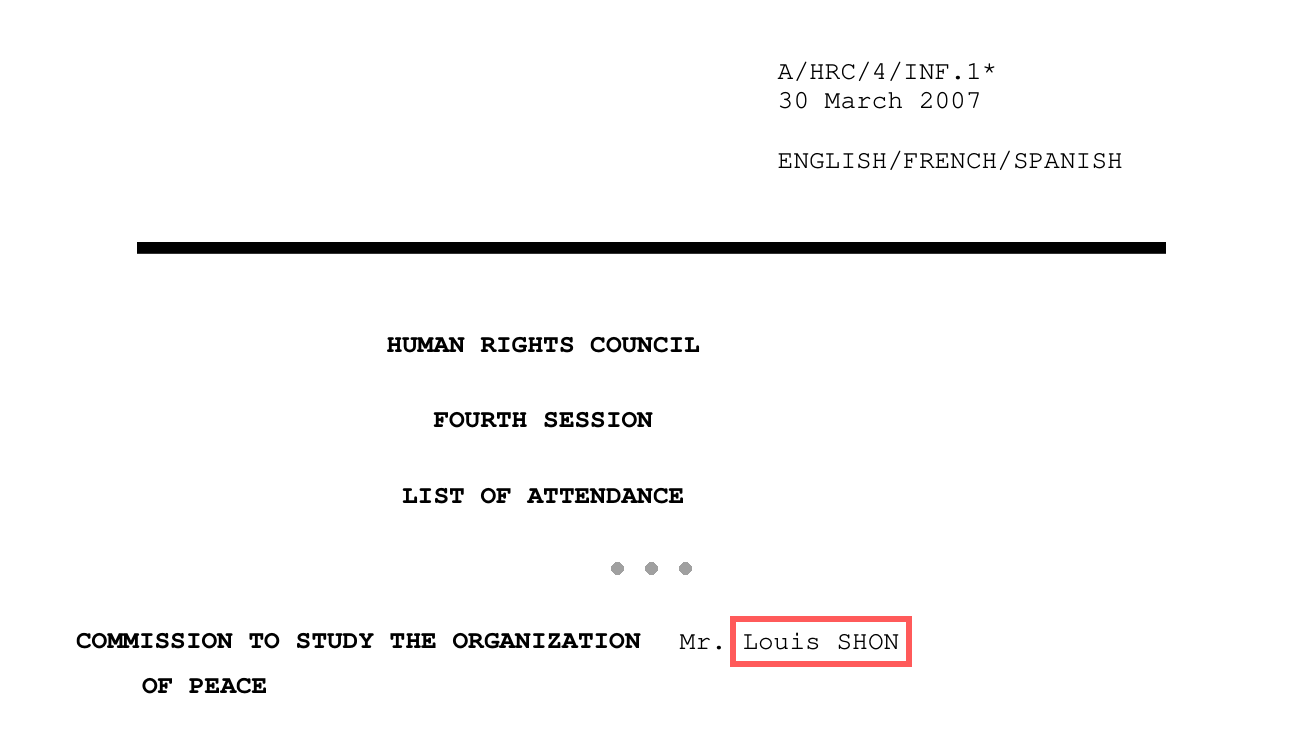 The Human Rights Council’s list of attendance for its fourth session, 30 March 2007. Sohn had died the previous June.
That detail comes from Indian Chronicles, a December 2020 investigation by the Brussels-based EU DisinfoLab into an operation it believes began in 2005. The researchers dedicated the report to Sohn. They found at least ten UN-accredited NGOs tied to a New Delhi company, the Srivastava Group, most of them defunct organisations brought back to life. One was the Canners International Permanent Committee, founded in Paris in 1938 to promote the consumption of tinned food. It stopped existing in 2007. In 2016 it got a new website, registered the same day as several other accredited NGOs’ domains, and the address it gave the UN was a rented Regus office in the US. The International Association of Seed Crushers was resurrected in a Regus office in London, though DisinfoLab could not formally tie that one to the network.
The resurrected NGOs spoke at the Human Rights Council, organised side events and protests, and kept criticism of Pakistan on the UN record. The words then needed an audience, and here the laundering got industrial. DisinfoLab traced more than 550 domain names and a network of 265 fake local news sites in 65 countries. A think tank that had dissolved in 2014 was publishing again in April 2020. A “human rights investigator” quoted in the coverage used a photograph of James Purnell, the former British cabinet minister, and a name DisinfoLab could find only in a satirical novel about the Raj. The copy was picked up by ANI, which DisinfoLab calls one of the biggest news agencies in India, and reposted from there by aggregators around the world.
The widely repeated figure of “750 outlets” is wrong. It adds the 265 fake sites to two third-party aggregators that simply republish ANI copy. Those aggregators are not part of the operation. And on who was behind it, DisinfoLab is unusually blunt: it says it could not gather enough evidence for a formal attribution and asks readers not to pin it on Indian intelligence. The trail it followed ends at the Srivastava Group.
India’s foreign ministry spokesperson answered on 11 December 2020: “As a responsible democracy, India does not practice disinformation campaigns,” adding that the best example of disinformation was “the country next door”. ANI’s editor called the report an attempt by Pakistan and its proxies to damage the agency’s credibility, according to Scroll. Nobody has been charged with anything.
Russia’s version skipped the charities and went straight for the mastheads. Doppelganger, mapped by EU DisinfoLab in September 2022 after German reporting by T-Online, built copies of European newspapers: virtually identical fonts and layouts, fake articles, sometimes a real reporter’s name on top. Readers arrived through social media posts. On the forged pages, every link that did not belong to the operation led back to the real site. According to the US Treasury, the fakes even reused the genuine outlets’ cookie consent pages. Somebody in Moscow made sure you could decline tracking cookies before reading the propaganda.
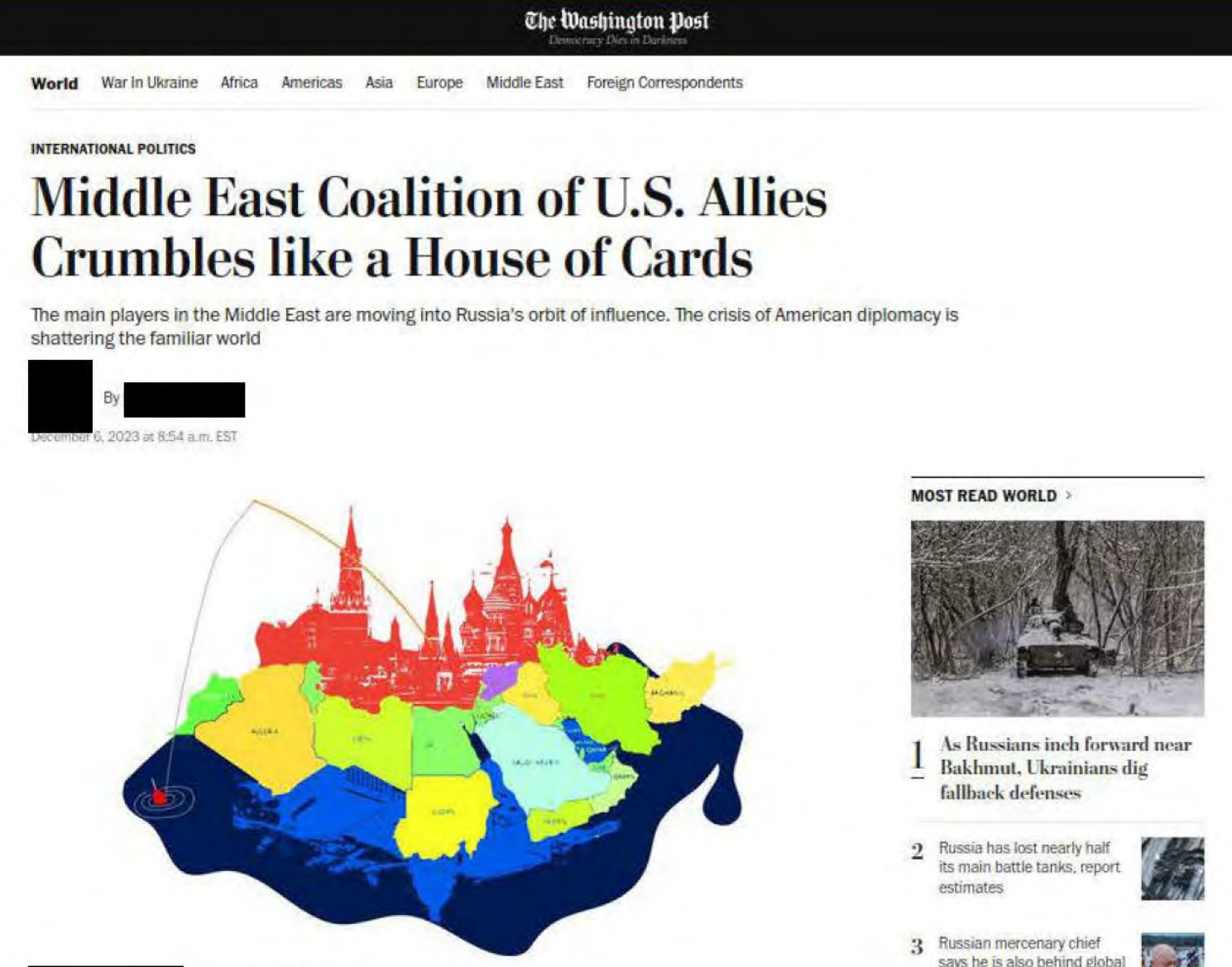 washingtonpost[.]pm, as captured in Exhibit 1 of the FBI’s affidavit. The byline and photo of the real reporter whose name was used are blacked out in the filing.
The attribution came in stages, and each stage needed a different kind of evidence:
| When | Who | Evidence | What it established |
|---|---|---|---|
| Sep 2022 | EU DisinfoLab, after T-Online | Open-source investigation | A network of cloned outlets; no formal attribution |
| Sep and Dec 2022 | Meta | Platform data: 1,633 accounts, 703 Pages | Originated in Russia, targeted mainly Germany (September); linked to two Russian firms, the Social Design Agency and Structura (December) |
| Jul 2023 | Viginum (France) | Technical analysis | At least 49 fake Le Parisien articles; 353 domain names listed, with Meta and DisinfoLab data |
| Mar 2024 | US Treasury | Sanctions designation | Both firms and their leaders sanctioned; “over 60 websites that impersonated legitimate news organizations” |
| Sep 2024 | FBI | The operators’ own documents | Enough for a judge to approve seizing 32 domains |
The affidavit, which also covers a fake Washington Post at washingtonpost[.]pm, is where the FBI told a judge what the Social Design Agency’s internal documents said. They planned 60,000 comments a month for France and Germany combined, and wrote down the recipe:
A minimum of fake news and a maximum of realistic information.
They also kept a file summarising fifteen publications that exposed their own work. The agency read its own exposure as a performance review.
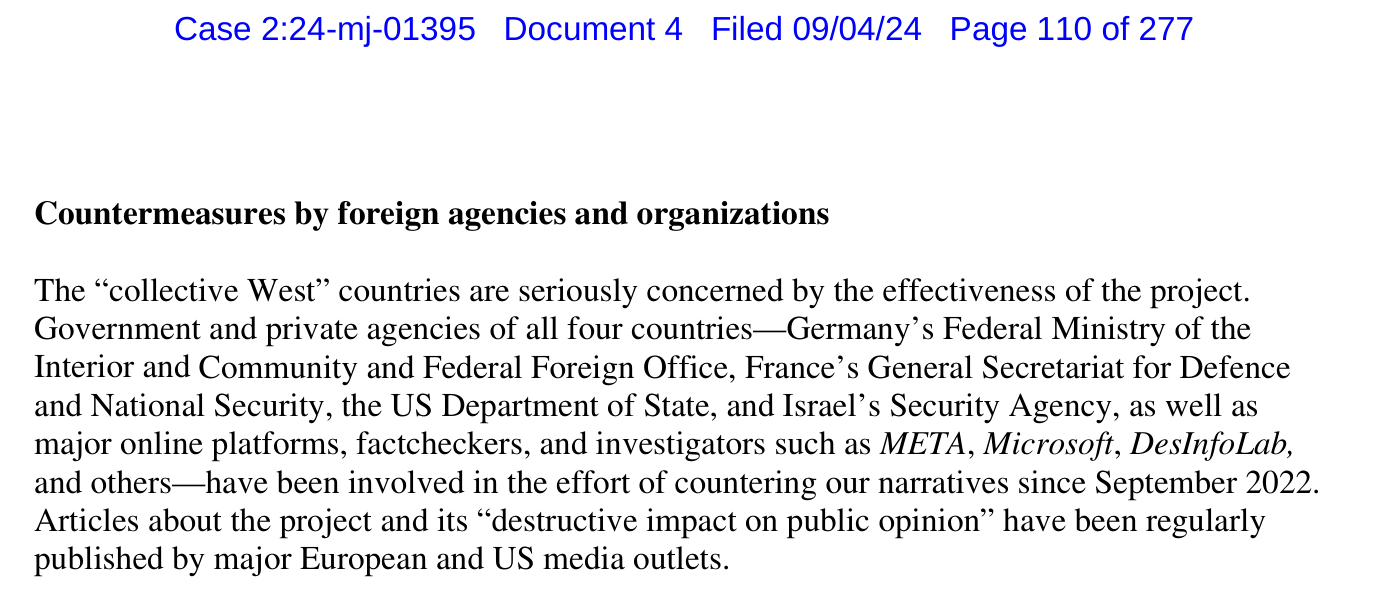 The Social Design Agency’s internal file, as filed with the FBI’s affidavit (page 110 of 277).
None of this is a conviction: the affidavit only had to show probable cause, and sanctions are an administrative designation. The method is the part nobody disputes. Le Parisien spent decades building its credibility, and anyone with a registrar account could borrow it.
The Doppelganger team borrowed newspapers. The next case borrowed people, and paid them very well.
On 4 September 2024 the US Justice Department unsealed an indictment against two employees of RT, Russia’s state broadcaster: Kostiantyn Kalashnikov and Elena Afanasyeva, charged with conspiring to violate the Foreign Agents Registration Act and to launder money. Both were at large when it was unsealed. Between October 2023 and August 2024, the DOJ says, about $9.7 million reached a Tennessee content company, nearly 90% of its deposits in that period. The wires came from shell companies in Turkey, the UAE and Mauritius. One wire of $318,800 carried the note “BUYING GOODS-INV.013-IPHONE 15 PRO MAX 512GB”. That is a lot of phones. The company posted nearly 2,000 videos and drew more than 16 million YouTube views.
The indictment says about $8.7 million went on to the production companies of three commentators. It also says two of them were told their backer was a private investor called “Eduard Grigoriann”, described in a one page profile as an “accomplished finance professional”. The indictment calls him a fictional persona. After the Moscow concert hall massacre in March 2024, according to the DOJ, Afanasyeva asked one of the founders to focus on “the Ukraine/U.S. angle”.
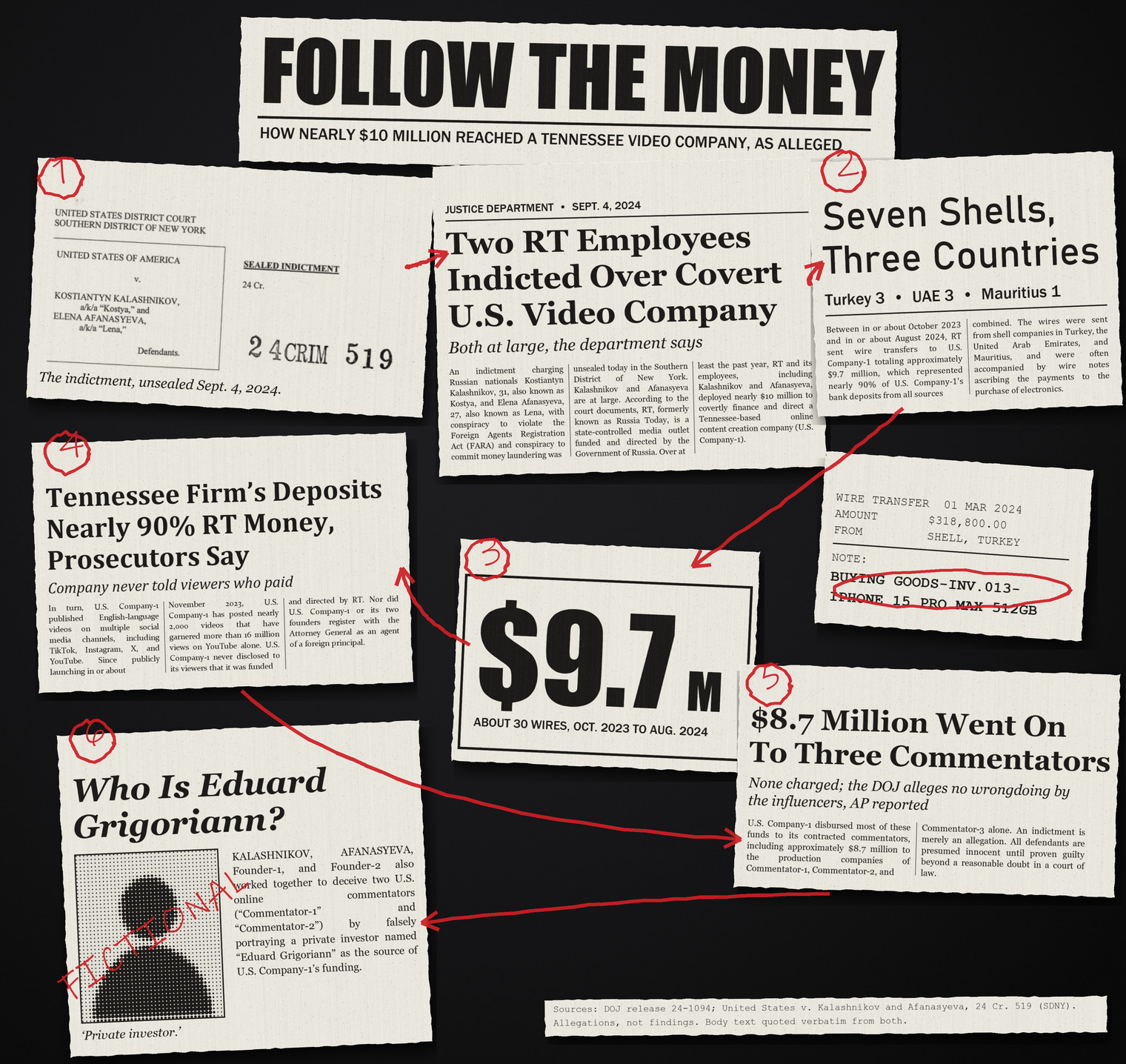
1. The indictment
“RT and its employees, including KOSTIANTYN KALASHNIKOV, a/k/a "Kostya," and ELENA AFANASYEVA, a/k/a "Lena," the defendants, have deployed nearly $10 million, laundered through a network of foreign shell entities, to covertly fund and direct U.S. Company-1.”
Unsealed 4 September 2024. An indictment is an allegation, not a finding.
United States v. Kalashnikov and Afanasyeva, 24 Cr. 519 (SDNY)
2. Seven shells
Three entities in Turkey, three in the UAE and one in Mauritius sent the wires, according to the indictment. None of them was the company's contract counterparty.
3. $9.7 million
“Between in or about October 2023 and in or about August 2024, the U.S. Company-1 Bank Account received approximately 30 wire transfers from foreign entities totaling approximately $9.7 million.”
4. Nearly 90%
“the approximately $9.7 million that U.S. Company-1 received from foreign wire transfers represented nearly 90% of all the deposits into the U.S. Company-1 Bank Account”
5. $8.7 million on
“U.S. Company-1 disbursed most of these funds to its contracted commentators, including approximately $8.7 million to the production companies of Commentator-1, Commentator-2, and Commentator-3 alone.”
No commentator is charged, and the DOJ does not allege wrongdoing by the influencers, AP reported.
6. The investor
“In truth and in fact, Grigoriann was a fictional persona.”
Once, the indictment says, "Eduard Grigoriann" replied to an email at 3:58 p.m. Paris time, searched for "time in Paris", and wrote: "Sorry, wrong hour. Didn't sync the calendar." It was 4:58 p.m. in Moscow.
The money trail as the indictment and the DOJ describe it. The small print is quoted from both; the clippings are mine. Allegations, not findings.
Real people are attached to this part. NBC and PolitiFact matched the indictment’s first two commentators, by subscriber counts, to Dave Rubin and Tim Pool. Neither is charged, and the DOJ, according to AP, does not allege wrongdoing by the influencers. Rubin said he “knew absolutely nothing about any of this fraudulent activity”. Pool said that if the allegations were true, he and the others “were deceived and are victims”, and he later disputed the indictment’s evidence.
The indictment treats the founders differently, and does not name them. The press identified them as Lauren Chen and Liam Donovan. Neither has been charged, and an indictment is, in the DOJ’s own words, “merely an allegation”. It alleges that while the commentators were being shown Eduard, the founders were privately calling their backers something else. From their earlier work for RT in 2021: “So we’re billing the Russians from the corporation, right?” In May 2023: “I’m gonna ask the russians about hiring” a producer. YouTube terminated the company’s channel and four channels run by Chen.
In February 2025 the new Attorney General narrowed criminal FARA charges to conduct “similar to more traditional espionage”. By Christmas 2025, according to the Columbia Journalism Review, Chen was back in the United States. By April 2026 she had a new podcast and White House access. Since coming back she has painted herself, in CJR’s words, as “an unwitting victim in a scheme concocted by Joe Biden’s DOJ”. Chen, Donovan and their lawyers did not respond to CJR, and I found no public statement from Donovan.
The United States does this too.
In August 2022, Graphika and the Stanford Internet Observatory published Unheard Voice, the largest covert pro-Western influence operation open-source researchers had ever examined. Fake personas posed as locals across the Middle East and Central Asia and pushed US-friendly narratives for almost five years. Twitter gave the presumptive origin as the US and Britain. Meta said the US. Neither named an operator. The campaign was also a flop. Only 19% of the covert accounts had more than 1,000 followers. The average tweet got 0.49 likes. The two most-followed accounts in the Twitter data were the overt ones that publicly declared a connection to the US military. The Washington Post reported that the Pentagon ordered a review.
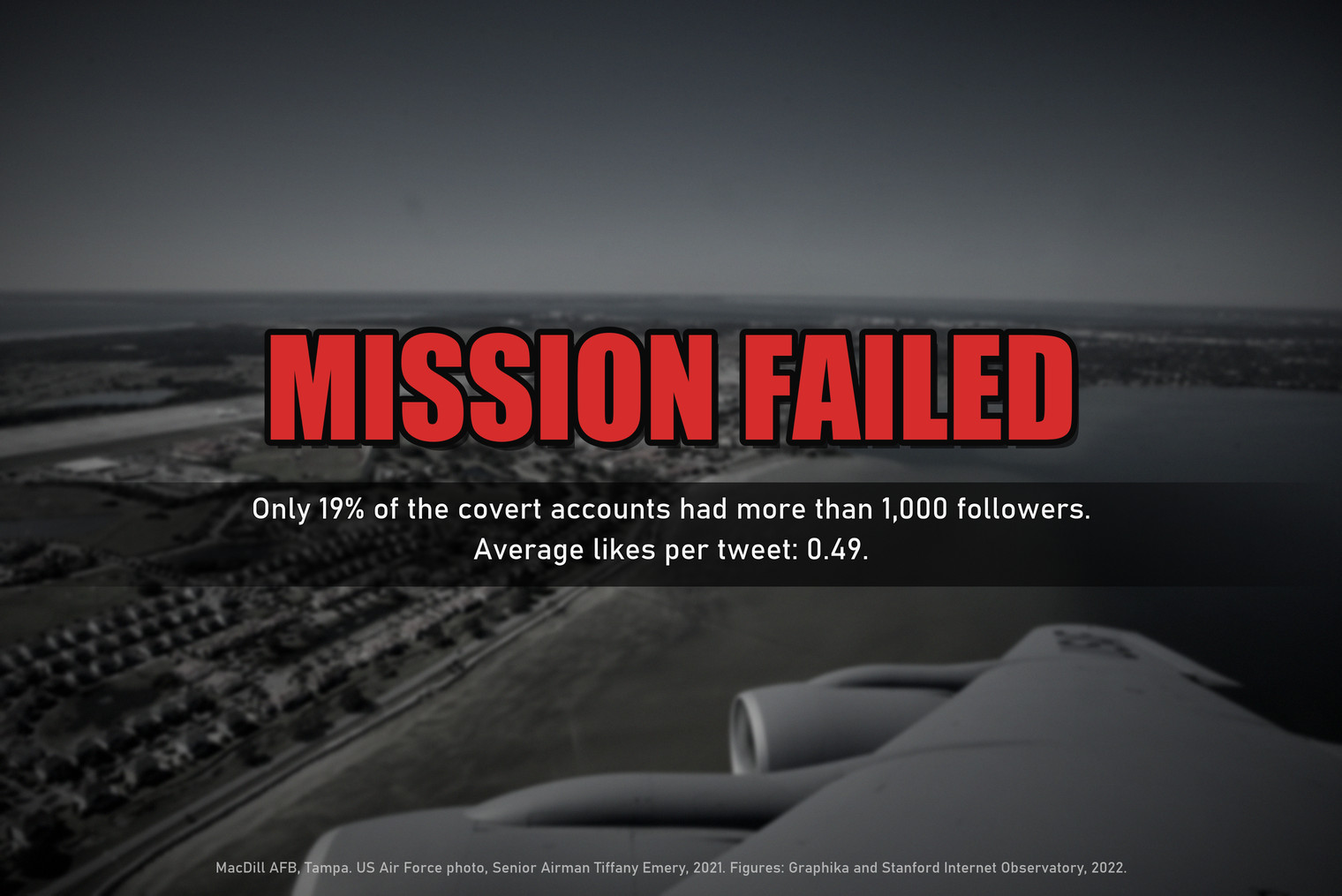
1. The loudest accounts
The two most-followed accounts in the Twitter data were the overt ones that publicly declared a connection to the US military. Graphika and Stanford named no operator.
Graphika and Stanford Internet Observatory, Unheard Voice, 2022
2. 19% and 0.49
Only 19% of the covert accounts had more than 1,000 followers, and the average tweet got 0.49 likes.
Graphika and Stanford Internet Observatory, Unheard Voice, 2022
3. MacDill, Tampa
Reuters traced the military's secret campaign against China's Sinovac vaccine to the psychological operations centre at MacDill Air Force Base. The photo is a US Air Force image, public domain.
Graphika and Stanford named no operator. Reuters later reported that Stanford had flagged some of the same accounts the Pentagon’s own review turned up. Photo: MacDill AFB, US Air Force (Senior Airman Tiffany Emery, 2021), public domain via DVIDS.
The Pentagon was already looking, and had found something worse. In June 2024 Reuters reported that the US military had run a secret campaign during the pandemic to discredit China’s Sinovac vaccine, starting in the Philippines. Reuters identified at least 300 accounts on X, almost all created in summer 2020, built around #Chinaangvirus, Tagalog for “China is the virus”. They posed as Filipinos. “COVID came from China and the VACCINE also came from China, don’t trust China!” read one from July 2020. The operation spread to Central Asia and the Middle East, where it pushed the claim that Chinese vaccines contained pork gelatin and were forbidden to Muslims. Reuters traced it to the military’s psychological operations centre at MacDill Air Force Base in Tampa.
It began under Trump and ran into Biden’s presidency until the White House ordered it stopped in spring 2021, and Reuters found posts continuing after that. At least six senior State Department officials had objected. “We’re stooping lower than the Chinese and we should not be doing that,” one told Reuters. A senior military officer involved put the thinking plainly:
We weren’t looking at this from a public health perspective. We were looking at how we could drag China through the mud.
For about a year Sinovac was the main vaccine available in the Philippines. In June 2021 only 2.1 million of the country’s 114 million people were fully vaccinated, and almost 24,000 Filipinos had died of COVID. That month Duterte went on television, masked, and told the country:
You choose, vaccine or I will have you jailed.
Reuters could not determine how far the posts spread or whether they cost lives, and I am not going to pretend otherwise. A former Philippine health secretary told Reuters she was sure many people died of COVID who did not need to.
A Pentagon spokeswoman said the military uses social media “to counter those malign influence attacks aimed at the U.S., allies, and partners”. The Pentagon’s audit, a person familiar with it told Reuters, faulted the main contractor, General Dynamics IT, for sloppy tradecraft in hiding the accounts’ origin. In February 2024 General Dynamics IT won a $493 million contract to keep providing clandestine influence services to the military.
In June 2024 the New York Times reported that Israel’s Ministry of Diaspora Affairs had commissioned a covert campaign aimed at American lawmakers, according to four Israeli officials and documents. The ministry allocated about $2 million and hired Stoic, a political marketing firm in Tel Aviv. Hundreds of fake accounts posed as Americans on X, Facebook and Instagram and urged more than a dozen members of Congress to keep funding Israel’s military. Many of the targets were Black Democrats, among them Hakeem Jeffries and Raphael Warnock. ChatGPT wrote many of the posts. The campaign also ran three fake English-language news sites.
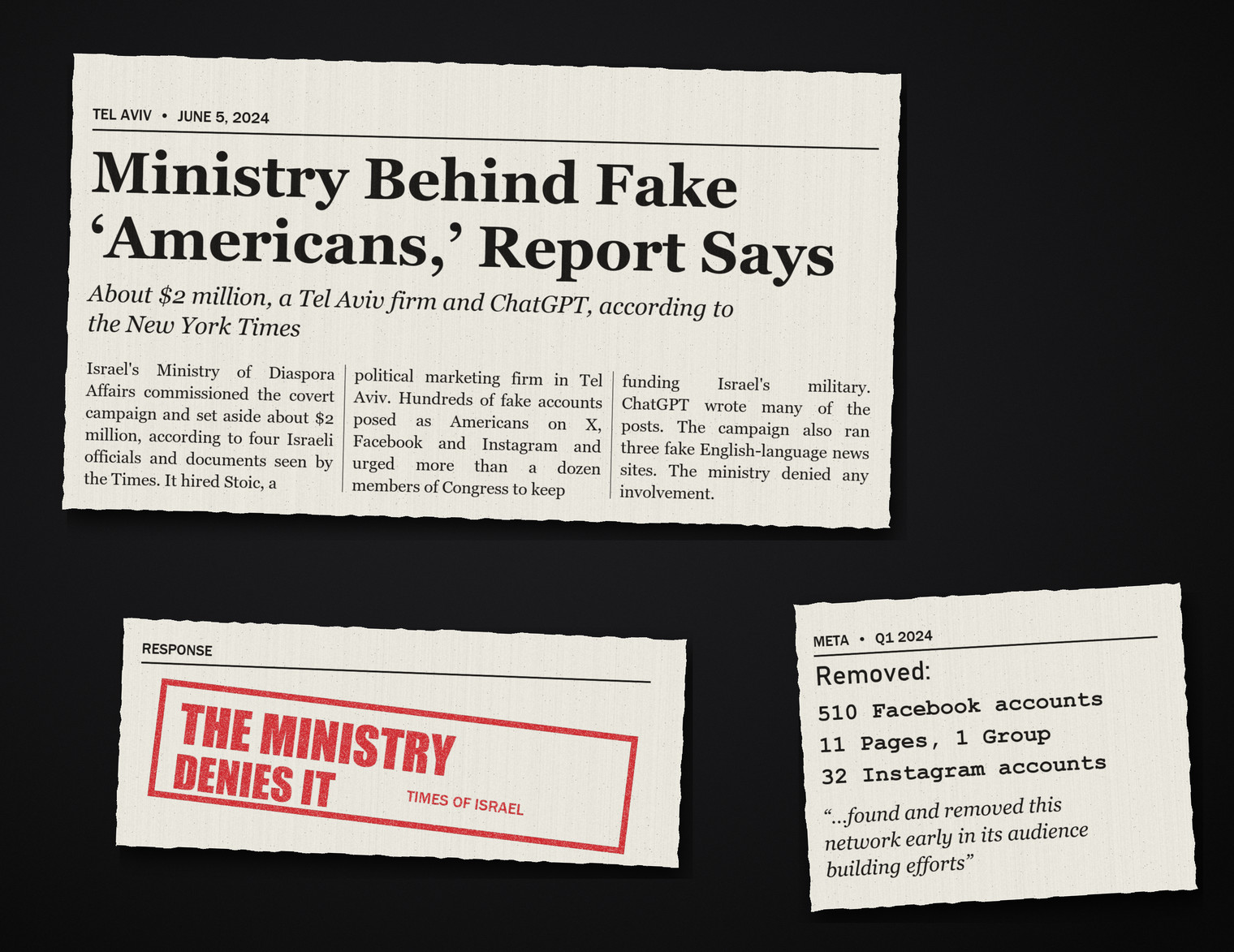
1. The report
Israel's Ministry of Diaspora Affairs commissioned a covert campaign aimed at American lawmakers and allocated about $2 million, according to four Israeli officials and documents seen by the New York Times.
2. Meta's takedown
“found and removed this network early in its audience building efforts”
510 Facebook accounts, 11 Pages, 1 Group and 32 Instagram accounts linked to Stoic.
The Stoic case on three scraps. Facts from the New York Times, Meta’s Q1 2024 threat report (quoted) and the Times of Israel; the wording and the clippings are mine.
The Israeli watchdog FakeReporter spotted it in March. Meta removed 510 Facebook accounts, 11 Pages and 32 Instagram accounts linked to Stoic and said it caught the network early. NBC reported that OpenAI disrupted it too. The ministry denied any involvement. Both companies’ reports said it drew little, if any, authentic engagement, according to NBC.
If the Times is right, a government paid a marketing firm to have a chatbot pretend to be American voters so that American legislators would feel lobbied by their own constituents. It is the Tenet model with the roles reversed. Tenet borrowed real Americans and hid the money. Stoic invented the Americans and hid the ministry.
The last case is the one where I have to be most careful, because the evidence runs out before the story does.
In May 2025 a car, a flat and a house linked to Keir Starmer were set on fire in north London. In June 2026 a 22-year-old Ukrainian builder, Roman Lavrynovych, was jailed for seven years for conspiring to commit arson, and a second man for two. The judge called Lavrynovych a “useful idiot” who had been “easily bought”. The man who hired him, a Telegram user called “EL”, was never caught, and the court did not establish who he was.
A BBC investigation published the same week went further than the court. It found that EL had recruited Lavrynovych in a jobs group for Ukrainians in London and first had him putting up posters for Direct Action UK, a supposedly British far-right group. The BBC concluded that Direct Action was run from Russia. Its messages carried Moscow timestamps and put the pound sign after the number, Russian style. After it offered money for Islamophobic graffiti, six mosques and an Islamic school in London were vandalised. The same network had earlier run a fake Islamic group paying people to spray religious graffiti, apparently to enrage the far right from the other side. When the arson suspects were arrested, Russia-based accounts spread a false claim that they were sex workers with a personal link to the prime minister. Tommy Robinson amplified it.
Robinson also appears in my liar’s dividend post, at the rally where the AI rapper played. The BBC does not say anyone directed or paid him.
The BBC says it found evidence suggesting EL is Evgeny Lyukshin, a 23-year-old Russian diplomat and the son of a senior official. It also says, plainly, that it does not know for sure. Lyukshin did not respond; hours after the BBC contacted him, a propaganda channel it had asked him about disappeared. The Russian embassy rejected any link. The head of Counter Terrorism Policing London said police could not prove who EL was or who he worked for, and had no evidence the attacks were state-backed. Unnamed sources told the BBC that British and Ukrainian authorities privately think otherwise.
| Case | Who alleges | What the primary source is | Denied by | Charged |
|---|---|---|---|---|
| Indian Chronicles | EU DisinfoLab | NGO investigation; no formal attribution | India’s foreign ministry, ANI | No one |
| Doppelganger | Meta, Viginum, US Treasury, FBI | Takedowns, sanctions, a warrant affidavit | No response found | No one in court |
| Tenet Media | US Justice Department | Indictment | Commentators named by the press; Russia’s foreign ministry | Two RT employees, at large when charged |
| Unheard Voice | Graphika, Stanford | Platform datasets, no attribution | n/a | No one |
| Sinovac campaign | Reuters | Investigation; Pentagon official acknowledged it | n/a | No one |
| Stoic | New York Times, Meta, OpenAI | Reporting, takedowns | Israel’s Diaspora Ministry | No one |
| Starmer arson network | BBC | Journalism; the court did not rule on it | Russian embassy | Three men, for the arson; two convicted |
In two of the seven operations the trail stops short of a government. One produced an indictment of a state’s own employees, and both were at large when it was unsealed. The contractor from the anti-vaccine campaign got a $493 million contract. One of the founders the press named got a podcast.
Credibility is built slowly, by newspapers, charities, wire agencies and people posting under their own names, and every operation in this post spent some that belonged to someone else. When getting caught costs this little, I expect to be writing about more of them. The next post is about a cheaper trick: leaving the real messenger in place and getting to edit the script.
One former troll's quota was 135 comments a day. One study found 1% of users got 70% of the exposure. It doesn't have to change your mind. It only has to fill it.
The invaders were Chinese until the edit. The Pentagon's contract says "remove the material". A jacket lost two flags, then got them back.
They fired the lawyers and the caretakers before the first missile flew; Minab is what the remaining machine produced.