A revolutionary flag at a Supreme Court justice’s beach house, a $59.99 Bible and a television network built on tithes: how a faith with nobody in charge goes to whoever claims it
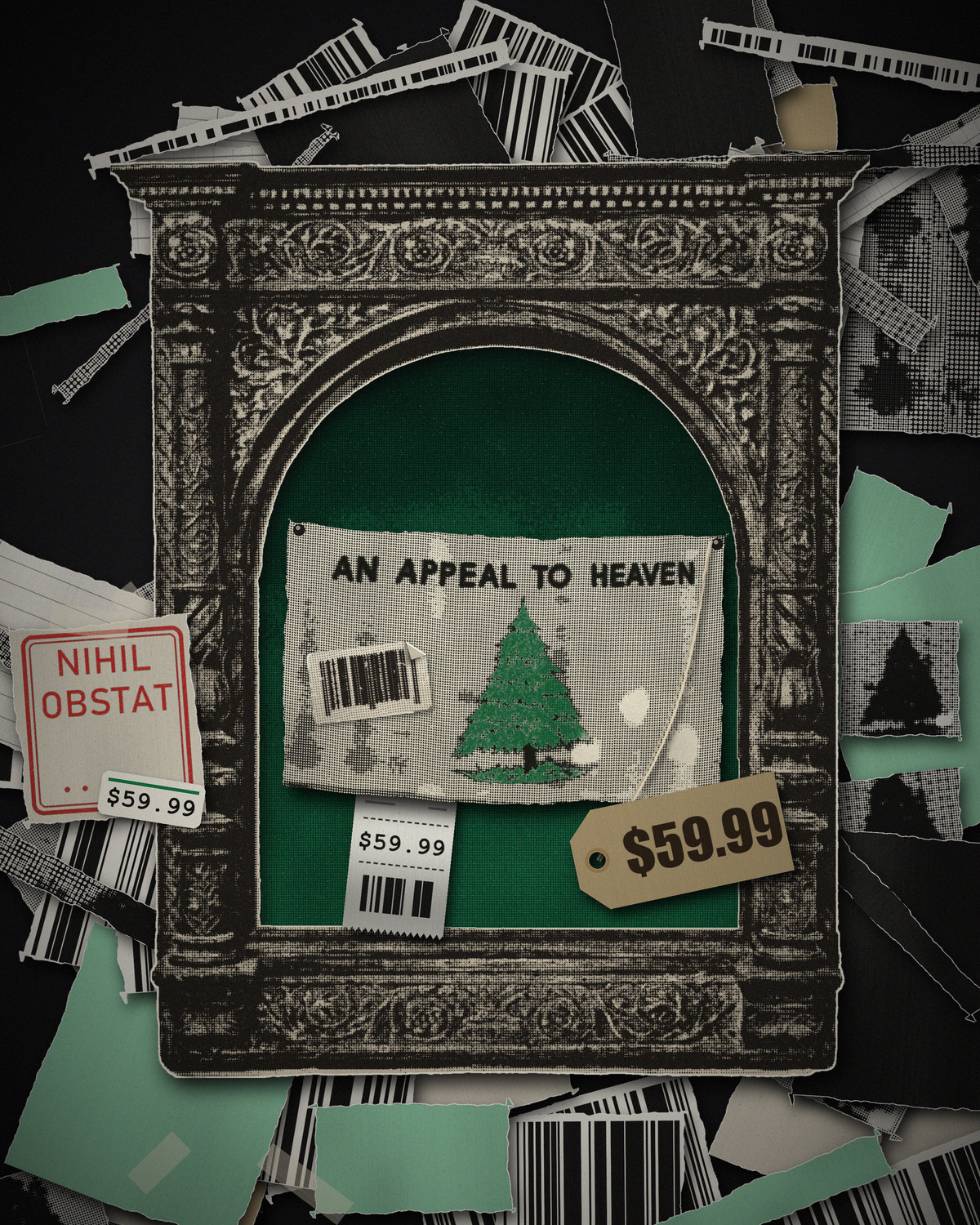
On 20 October 1775 Joseph Reed, George Washington’s secretary, wrote from headquarters at Cambridge to Colonel John Glover and Stephen Moylan at Salem, who were fitting out armed vessels for the general. Most of the letter is errands. Moylan is to hold on to 260 dollars until he gets back. A colonel has not finished an order. A doctor called Spofford has been pursued “all Day” for an answer and will go. Keep back some flour for the vessels. Then, because the ships will need to know one another at sea, he asks them to settle on a colour and a signal, and offers a flag of his own: “What do you think of a Flag with a White Ground, a Tree in the Middle”. The motto would be “(Appeal to Heaven)”, and “This is the Flag of our floating Batteries”. After that it is errands again, half a dozen reams of the best writing paper to be had at Salem or Marblehead. The wording is from volume 2 of Naval Documents of the American Revolution, the Navy’s edition, page 538, printed from the Washington Papers at the Library of Congress.
Page 538 of Naval Documents of the American Revolution, vol. 2, made into a pop-up; the clippings quote sources 5, 8, 13, 17, 21 and 24.
The phrase is older than the flag. In the Second Treatise of Government, published in 1690, John Locke uses it for people who have “no appeal on earth to right them”: they “are left to the only remedy in such cases, an appeal to heaven.” The next section calls this the state of war, “where there is no authority to decide between the contenders”. The Princeton historian Anthony Grafton put it more bluntly to the New York Times, as the Philadelphia Inquirer reported: “there’s no one else you can ask for help or a judgment.”
Who Flew It
The flag came back two centuries later as a preacher’s project. Dutch Sheets, a leading figure in the New Apostolic Reformation, wrote a 2015 book called An Appeal to Heaven and teaches, according to Rolling Stone, that the pine is an evergreen from Genesis standing for an “everlasting covenant” with God. On 6 January 2021 it was at the Capitol. CNN says it “appeared among crowds” there; two Baylor University communication scholars writing in The Conversation say it was “in the hands of insurrectionists, including the Proud Boys”.
In May 2024 the Times reported that the same flag had flown at Justice Samuel Alito’s holiday home on Long Beach Island, New Jersey, in July and September 2023 (via the Inquirer and SCOTUSblog). On 29 May Alito wrote to Senators Durbin and Whitehouse to say he would not step aside from the January 6 cases. His letter puts the flag on his wife:
I was not familiar with the “Appeal to Heaven” flag when my wife flew it.
He wrote that he “had no involvement in the decision to fly that flag”, that he “assumed she was flying it to express a religious and patriotic message”, that he was not aware of any connection between it and “the ‘Stop the Steal Movement,’ and neither was my wife”, and that “the use of an old historic flag by a new group does not necessarily drain that flag of all other meanings”. The house, he added, is titled in her name. So the record holds a flag on a pole and a justice’s account of who raised it and what he took it to mean. It holds nothing from the woman who raised it, so this post treats the flag as a display and leaves her intentions alone.
Locke’s phrase described a quarrel with nobody left to decide it. This series asks of each case who could have said no, and in the American church market the sharper version is who has the standing to object. I assumed the record would hold a pastor who refused to bless a candidate and lost his congregation to a rival who didn’t. No study I read has one. The sources support something narrower: with no one in charge, a refusal has nothing behind it, it costs the person who makes it, and political fit shapes where people worship and who leaves. Brazil, at the end, is built the other way round. There one man owns the church and the broadcaster, and the only person with the standing to object is the man doing the claiming.
The strongest evidence against this series, Radha Sarkar and Alexander Coppock’s 2026 reanalysis of 43 studies, puts the pooled effect of religious messages and endorsements on political attitudes at about a point on a 100-point scale, which cannot be told from zero. Those studies test whether a religious message changes a mind, and part one explains why that is a different question from who gets to hand out the blessing.
The Shop
On 26 March 2024 Donald Trump posted a video on Truth Social selling the “God Bless the USA” Bible, a King James Version bound with the Constitution, the Declaration of Independence, the Bill of Rights and the Pledge of Allegiance. Trade records reviewed by the Associated Press show a printer in Hangzhou, China, shipping close to 120,000 of them to the United States that year. AP puts the estimated value of the three shipments at $342,000, “or less than $3 per Bible”. The minimum price was $59.99, which by AP’s estimate made the potential sales revenue about $7 million.
Clippings quote AP and Christianity Today, including Tim Wildsmith’s “a money grab”; the Constitution is the National Archives transcription.
The website that sells it says it is not owned or controlled by Trump, and uses his name and image “under a paid license from CIC Ventures”. AP found CIC Ventures had earned $300,000 in Bible sales royalties, according to a disclosure released in August 2024. Financial forms released in June 2025 showed Trump made $1.3 million from Bible sales in 2024, according to Christianity Today, which also found him listed as CIC Ventures’ “manager, president, secretary, and treasurer”. His annual report for 2025, received by the Office of Government Ethics on 29 June 2026, lists “The Greenwood Bible” under CIC Ventures as a royalty of $208,486. That is about $1.5 million across the two annual reports. I have not added AP’s $300,000, which probably covers some of the same months.
The royalty goes to the licensing company. The books, by AP’s account of the trade records, were printed by New Ade Cultural Media in Hangzhou and imported by Freedom Park Design, a company in Alabama. Special editions sell for $99.99. Religious books, US Customs and Border Protection told Christianity Today, are exempt from tariffs on Chinese imports.
The Count
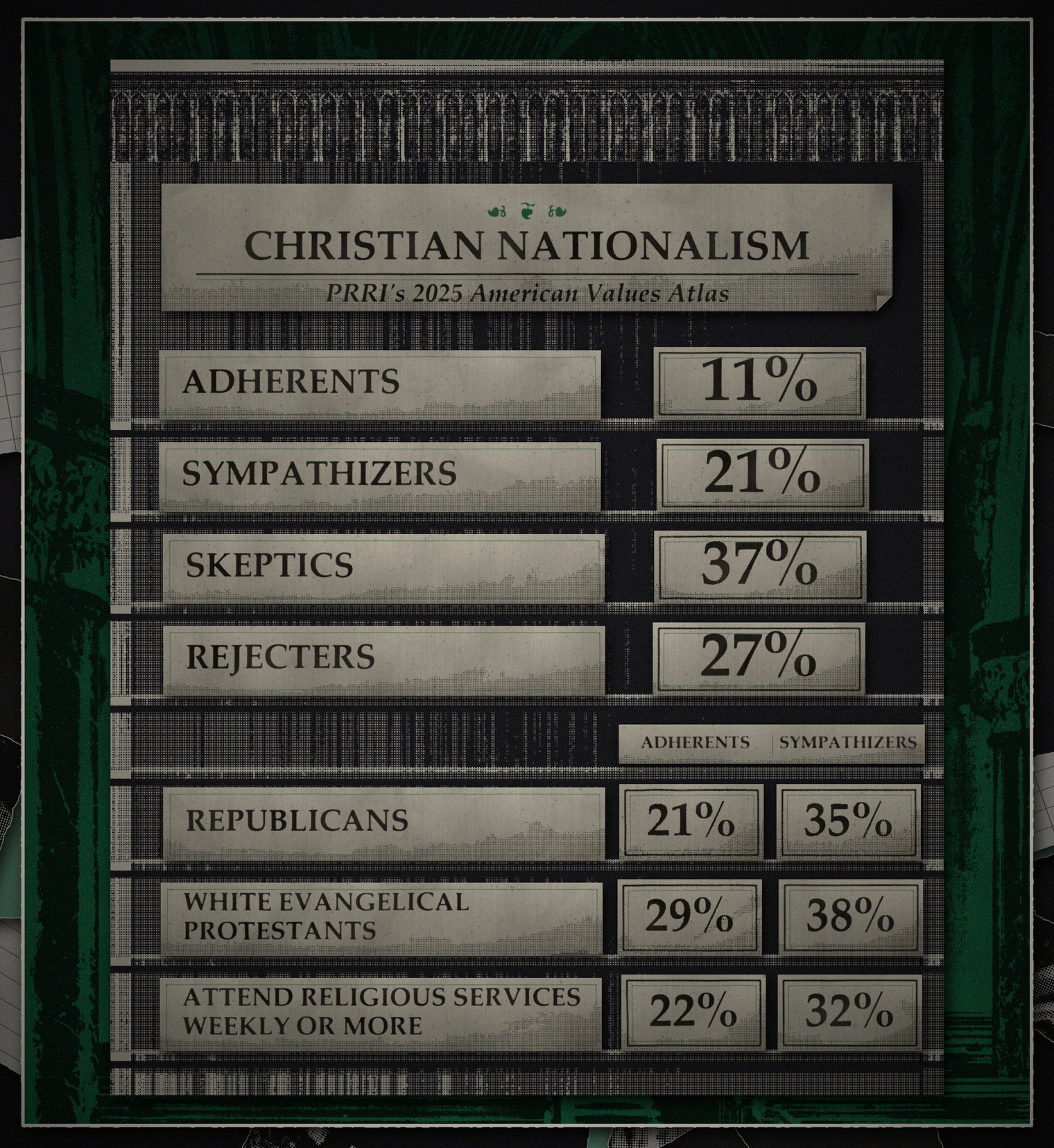
PRRI’s 2025 American Values Atlas interviewed 22,111 adults online between 28 February and 8 December 2025 and published on 17 February 2026. It scores people on five statements, among them “The U.S. government should declare America a Christian nation” and “Being Christian is an important part of being truly American”. By that scale 11% of Americans are Christian nationalism Adherents and 21% Sympathizers, against 37% Skeptics and 27% Rejecters. Among Republicans it is 21% and 35%. Among white evangelical Protestants, 29% and 38%.
The figures and labels are PRRI’s.
Part one found the cross easiest to take in Western Europe where the pews were emptiest. In PRRI’s data the gradient runs the other way: 54% of Americans who attend services weekly or more are Adherents or Sympathizers, against 20% of those who seldom or never go.
PRRI also asked whether “true American patriots may have to resort to violence” to save the country. Thirty per cent of Adherents and 23% of Sympathizers agreed, and so did 14% of Skeptics and 11% of Rejecters, which says something about how many people will agree with that sentence at all. Most Adherents (66%) and Sympathizers (74%) disagreed. Measures like this have critics. The sociologist George Yancey argued in Christianity Today in January 2026 that Christian nationalism scales in general (he does not name PRRI’s) mistake conservative identity politics for something else, drawing on an online survey of 38 conservative Christians who strongly support Trump.
White evangelical Protestants voted for Trump by 77% to 16% in 2016, by Pew’s validated-voter study. Pew put the 2020 figure at 84% in its first study and at 83% in its latest; in 2024 it was 81%.
Nobody in Charge
So who in American Protestantism could tell a candidate he may not have the label? The largest Protestant denomination answers the question itself. The Southern Baptist Convention’s FAQ says:
The SBC is not a church and has no authority to renounce, censure, investigate, or otherwise attempt to discipline members of any local church.
Its resolutions, the same page says, “are not binding upon any individual church or successive Convention.” The convention can still speak. At Indianapolis in June 2024 the messengers adopted a resolution that says “we oppose any effort to establish a state religion of any nation, including the United States of America”, and rejects “any government coercion or enforcement of religious belief, including blasphemy laws”. An attempt to delete the state-religion paragraphs failed on a show of ballots, Baptist News Global reported, after a messenger told the hall: “There is no such thing as the separation of God and state.” The resolution passed, and by the convention’s own account it binds no church in the country.
What a refusal can cost shows in the case of Russell Moore, who ran the convention’s ethics commission and was, Religion News Service reported, its most outspoken “Never Trumper”. An Executive Committee task force blamed his commission for the loss of more than a million dollars in church giving, and among the reasons churches gave for withholding it the report listed, in RNS’s summary, Moore’s opposition to Trump. Moore resigned in 2021. A letter he had written more than a year earlier tells it differently: most Trump supporters he met had been “nothing but kind and encouraging”, and “the presenting issue here is that, first and foremost, of sexual abuse”, with race the other. The task force itself had been set up to measure what the commission’s statements were doing to giving.
In December 2019 Christianity Today, the magazine Billy Graham founded, said in an editorial by its outgoing editor, Mark Galli, that Trump “has abused his authority for personal gain” and should be removed from office. Nearly 200 evangelical leaders signed a letter against it, CNN reported, among them Ralph Reed, no relation to Washington’s secretary, president of the Faith and Freedom Coalition. Trump called it “a far left magazine” that “knows nothing about reading a perfect transcript”.
Where the Flock Goes
If the people in the pews disagree with their pastor, they can leave, and they do. Lifeway Research found in 2023 that 53% of regular Protestant churchgoers have attended more than one church as adults. Among switchers who did not move house, 22% left over the church’s teaching or positions on issues, and one in three of those said the pastor or church “seemed aligned with a particular political party or ideology”. It runs both ways: 28% of that group found their old church too liberal, and 23% too conservative.
Paul Djupe, a political scientist at Denison University, told Lifeway in 2018 that “it was marginal attenders in churches who were exposed to disagreement that were likely to leave”. For a frequent attender engaged in church life outside worship, he said, “these disagreements didn’t make much difference.”
The Collection
Lance Wallnau, a preacher based in Keller, Texas, has for a decade “played a vital role in building the myth of Trump as a strongman anointed by God”, in the words of Religion News Service, which quotes him: “There is a Cyrus anointing on this man.” RNS also runs a picture of him selling a gold coin featuring King Cyrus and President Trump on the Jim Bakker Show in May 2019.
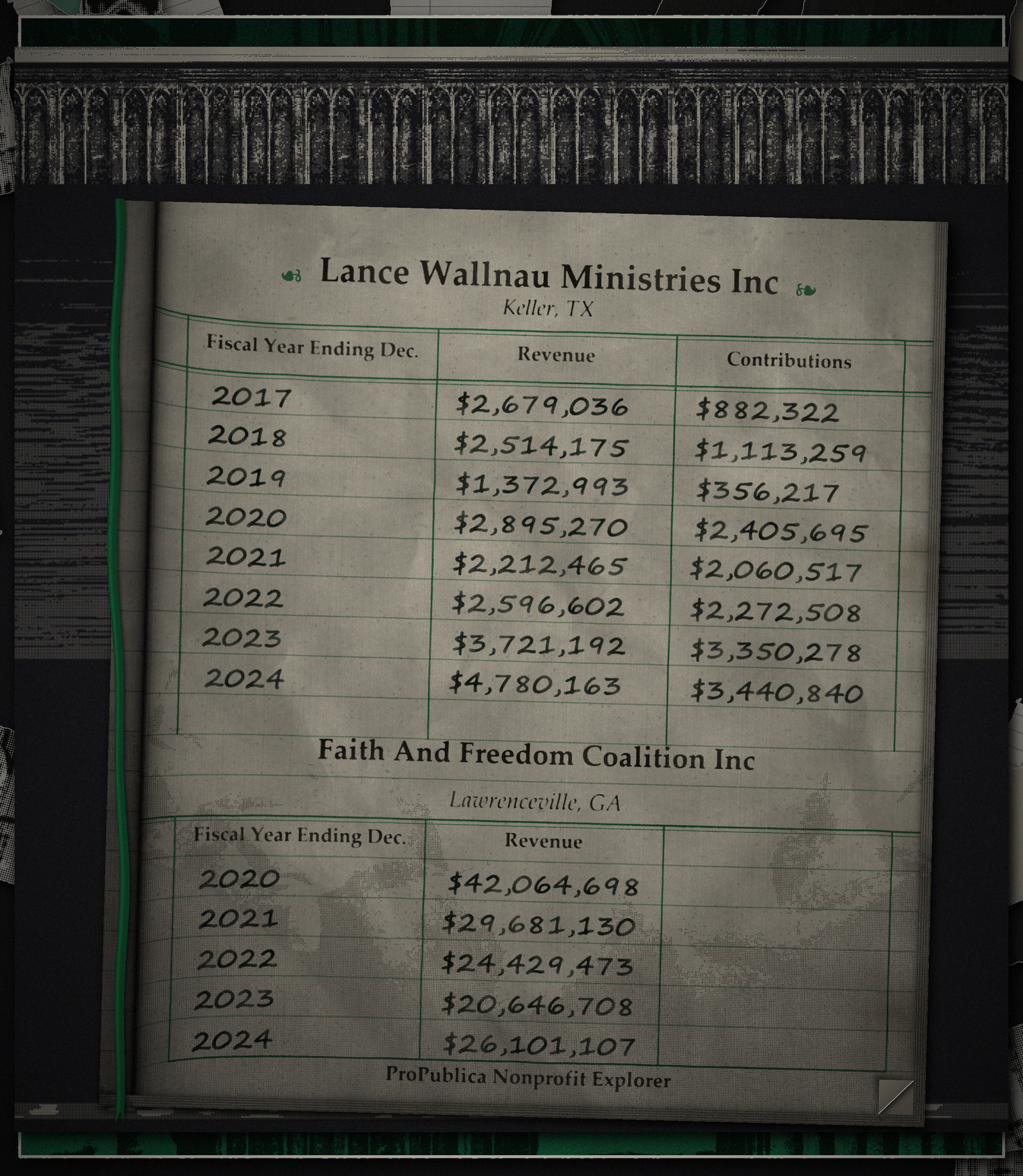
Revenue and contributions as filed, from ProPublica’s Nonprofit Explorer.
The tax filings of Lance Wallnau Ministries show revenue of $2.68 million in 2017, a low of $1.37 million in 2019 and $4.78 million in 2024, the highest of the years ProPublica has figures for. The mix changed too. In 2019 contributions were 26% of revenue and net inventory sales 47%. In 2023 contributions were 90%, and in 2024, 72%. The Faith and Freedom Coalition, whose president signed the letter against Christianity Today, is a 501(c)(4) political group. Its revenue peaked at $42.1 million in the election year of 2020, fell to $20.6 million in 2023 and was $26.1 million in 2024.
The Owner’s Church
In Brazil there is someone in charge. In 1989 Edir Macedo, who founded the Universal Church of the Kingdom of God in 1977, bought the Record television and radio stations with his wife, according to the Media Ownership Monitor, which lists the Macedo family as Grupo Record’s owner, 100%, and describes “an ambiguous relationship between the group’s medias and the church he leads”. Bloomberg Businessweek, as summarised by InfoMoney in 2013, reported that the price was $45 million, that the tax authorities found he had paid with interest-free loans from the church, and that Macedo, who first said he bought it for the church, later said he bought it for himself. A federal judge ruled in his favour in 2011. The church, the same report says, buys up to six hours of Record’s airtime a day, mostly after midnight.
In 2018 Bolsonaro skipped the televised debates, citing his health after he was stabbed in August. On 4 October, while the other candidates debated on Globo, he gave RecordTV a 26-minute interview, “some days after the owner of Record, Edir Macedo”, had declared his support, the Monitor records. Brasil de Fato reported that Fernando Haddad’s coalition asked the electoral court to stop the broadcast, and that the court’s Carlos Horbach let it air, calling a ban “censura prévia”, prior censorship. Record was not alone: earlier in the first round, the Monitor notes, he gave an exclusive interview to RedeTV! and a 45-minute one to Band.
Wording from the Media Ownership Monitor and Brasil de Fato.
On 8 January 2023 Bolsonaro’s supporters stormed Congress, the Supreme Court and the presidential palace. Video showed some of them carrying Bibles and singing hymns, Christianity Today reported, and in one video filmed inside Congress a voice says: “The Congress is our church.” Agência Lupa cross-checked the official list of 1,398 detainees against the national register of business activities and found at least four pastors who own churches. Thirteen more religious leaders appear in Lupa’s crowd-sourced database inciting or joining the attacks.
AtlasIntel polled 2,200 adults online on 8 and 9 January, the day of the riot and the day after. Among evangelicals, 64.3% said they favoured “uma intervenção militar para invalidar o resultado da eleição presidencial”, a military intervention to invalidate the election result. In the same poll 15.5% of evangelicals favoured installing a military dictatorship and 71.1% opposed it, and 31.2% agreed with the people who occupied the buildings.
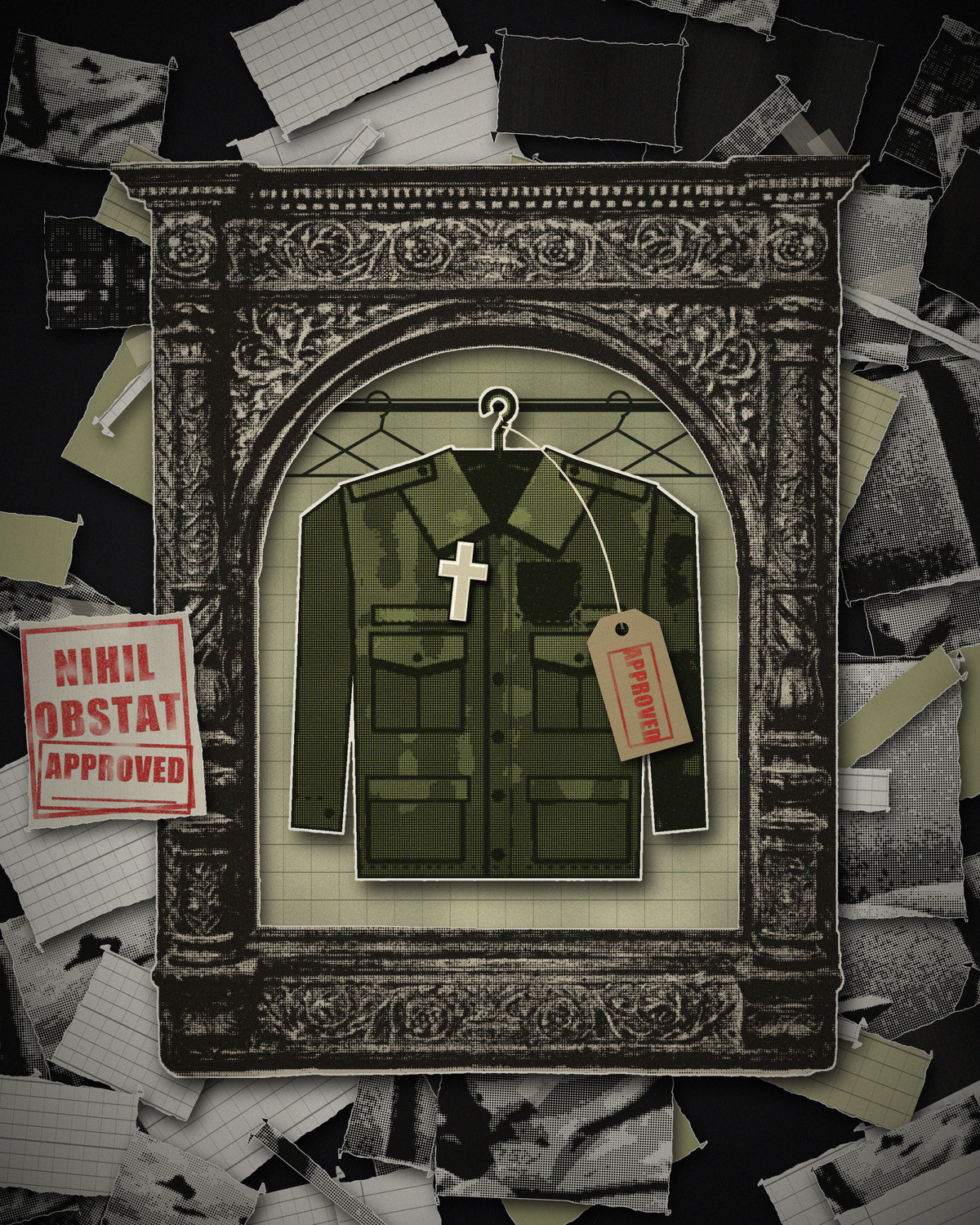
Nihil Obstat
In part one the stamp meant something because a censor signed it and a bishop stood behind him. The Southern Baptists passed a resolution against a state religion, and their own FAQ says its resolutions bind no church. A convention task force listed Moore’s criticism of Trump among the reasons churches withheld giving from his commission; Moore said the presenting issue was sexual abuse, with race the other. When Christianity Today’s editor called for Trump’s removal, the letter answering the magazine carried Ralph Reed’s name, and Reed’s coalition took in $42.1 million the following year. Members who disagree can leave, and the ones most likely to go are the least attached. In Brazil the man with the standing to object founded the church, owns the network that put Bolsonaro on air, and backed him.
Joseph Reed’s flag carried Locke’s phrase for people with no judge on earth to turn to. The movement flying it now has no judge either. Who could have said no? Nihil obstat.
Justice Samuel A. Alito Jr., letter to Senators Richard J. Durbin and Sheldon Whitehouse (scan hosted by Reason). “Letter of 29 May 2024.” 29 May 2024.
Donald J. Trump, OGE Form 278e, annual report for 2025 (hosted by Citizens for Responsibility and Ethics in Washington). “Donald J. Trump 2026 278 Annual.” Received by OGE 29 Jun 2026; Part 2 schedule, line 24.5.
Church interior in the hymn board, the ledger, the Bible animation’s clippings and the scraps under the Brazil sheet and the clippings in the pop-up animation: Library of Congress Photochrom Print Collection. “Bodelwyddan Church (interior), Rhyl, Wales.” c. 1890 to 1900, public domain. The hymn board, cards and the Brazil listings sheet are drawn for this post.
Paper and wood textures: Photos Public Domain, “Crumpled olive green paper”, public domain; Bango Textures (ISO Republic), “Wood Texture Background”, CC0. Both via Wikimedia Commons, used for creases and grain only.
Bible animation, rendered in Blender: ambientCG, “Leather030” and “Fabric034”, CC0; Poly Haven, “Studio Small 09” HDRI, CC0. The book, wrap, slips, clippings and animation are made for this post. The pop-up animation is also rendered in Blender; its flag is the hero’s (source 36), and the pop-up, clippings and stamp are made for this post.
Britain sanctioned Xinbi with two wallets that were already dead. The money stopped a day before the announcement, when, by an analytics firm's account, a US agency went to Tether. The first new wallet opened 26 minutes later. This part asks who kept the gate open.
A Facebook ad for a waiter, a Telegram channel with 6,564 members and a frozen wallet the FBI ties to Xinbi. This is who the scam compounds recruit, and where the paper trail stops.
 The figures and labels are PRRI’s.
 Revenue and contributions as filed, from ProPublica’s Nonprofit Explorer.
 Wording from the Media Ownership Monitor and Brasil de Fato.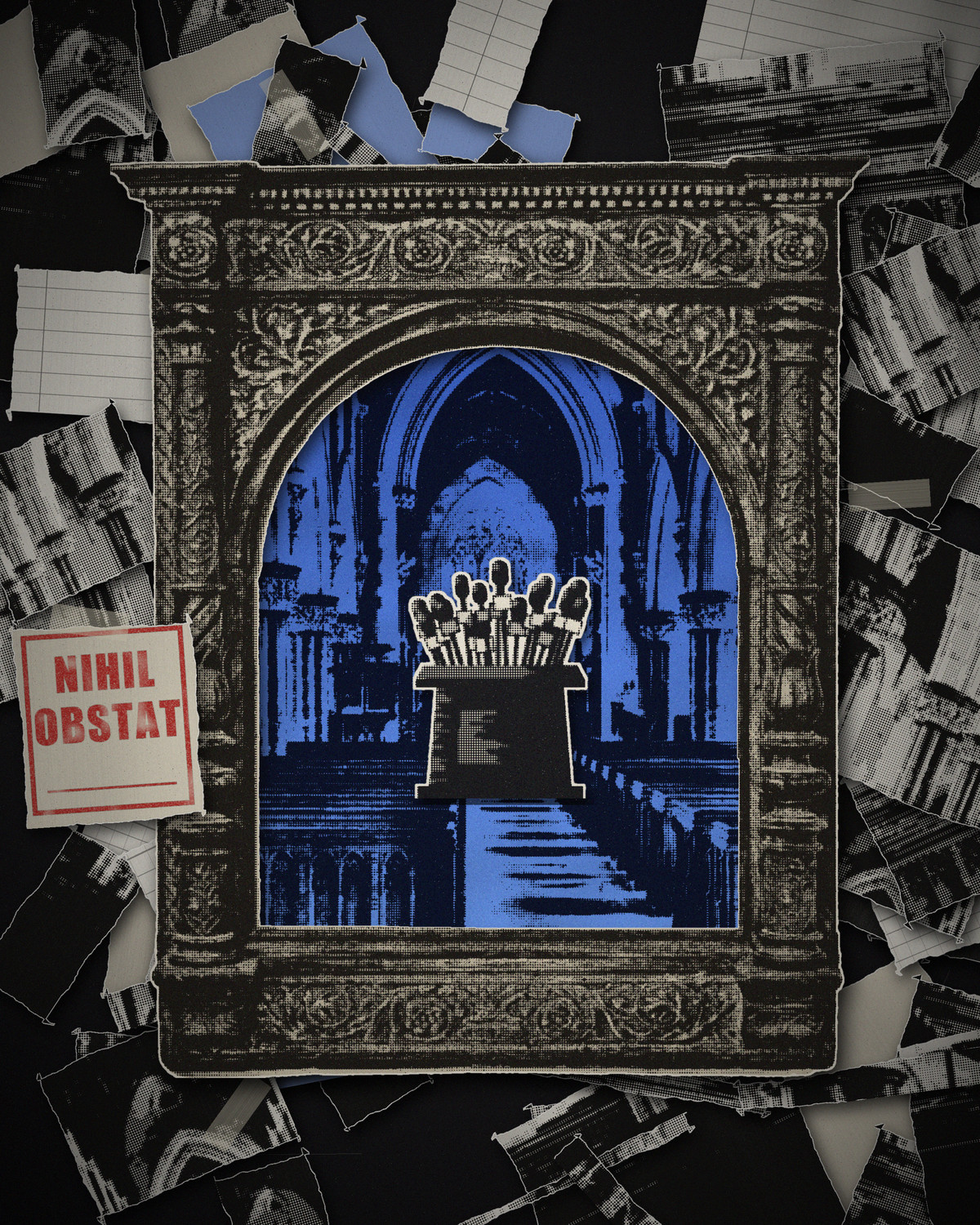





,_Rhyl,_Wales-LCCN2001703541.jpg)


