A Church that sided with a government and lost the country’s trust, a patriarch who told soldiers their sins would be washed away and a Pentagon that rewrote its chaplains: how the people who could say no get signed up
The form is due on 16 October. Active-duty airmen and guardians have until then to update their religious affiliation code, Air Force Times reported on 29 September, and anyone who misses the deadline will have their record changed automatically to an “approved transition construct”. The codes are new. In May the Pentagon cut its list of recognised faiths and belief systems from more than 200 to 31, and Atheists, Humanists, Pagans and Wiccans are among the ones no longer on it.
The procedure, on a loop.
The next day Pete Hegseth, the Secretary of War, gave his State of the Force address. According to the department’s own transcript, he told the audience that the military had “sidelined” its chaplains “with paperwork and process. And that ends now.” Then he announced a new office, set up that day by memorandum. Near the end of the religious passage came the line this post is named for:
Our department is, you might say, is putting on the full Armor of God. Because while we wage physical war, we all know the real battle is spiritual.
The question this series puts to every case is who could have said no. Here it goes to people who had the standing to say it: what happens when the one who could object signs up? An authority that lines up behind a government can lose the public’s trust, and Poland shows that as a correlation, nothing stronger. An authority that will not line up can be rewritten from inside by whoever employs it, and the Pentagon is doing that on paper, one memo at a time.
One study cuts against the whole series: pooling 43 experiments, Radha Sarkar and Alexander Coppock found that religious messages and endorsements move political attitudes too little to tell from zero. That is a finding about persuasion, and this post is about who controls the institutions that hand out a blessing, which part one explains is a separate question.
The Bishop’s Thanks
On 22 October 2020 Poland’s Constitutional Tribunal ruled that the law allowing abortion on the ground of severe foetal defect was incompatible with the constitution. That evening Archbishop Stanisław Gądecki, president of the Polish bishops’ conference, issued a statement, carried by Vatican News:
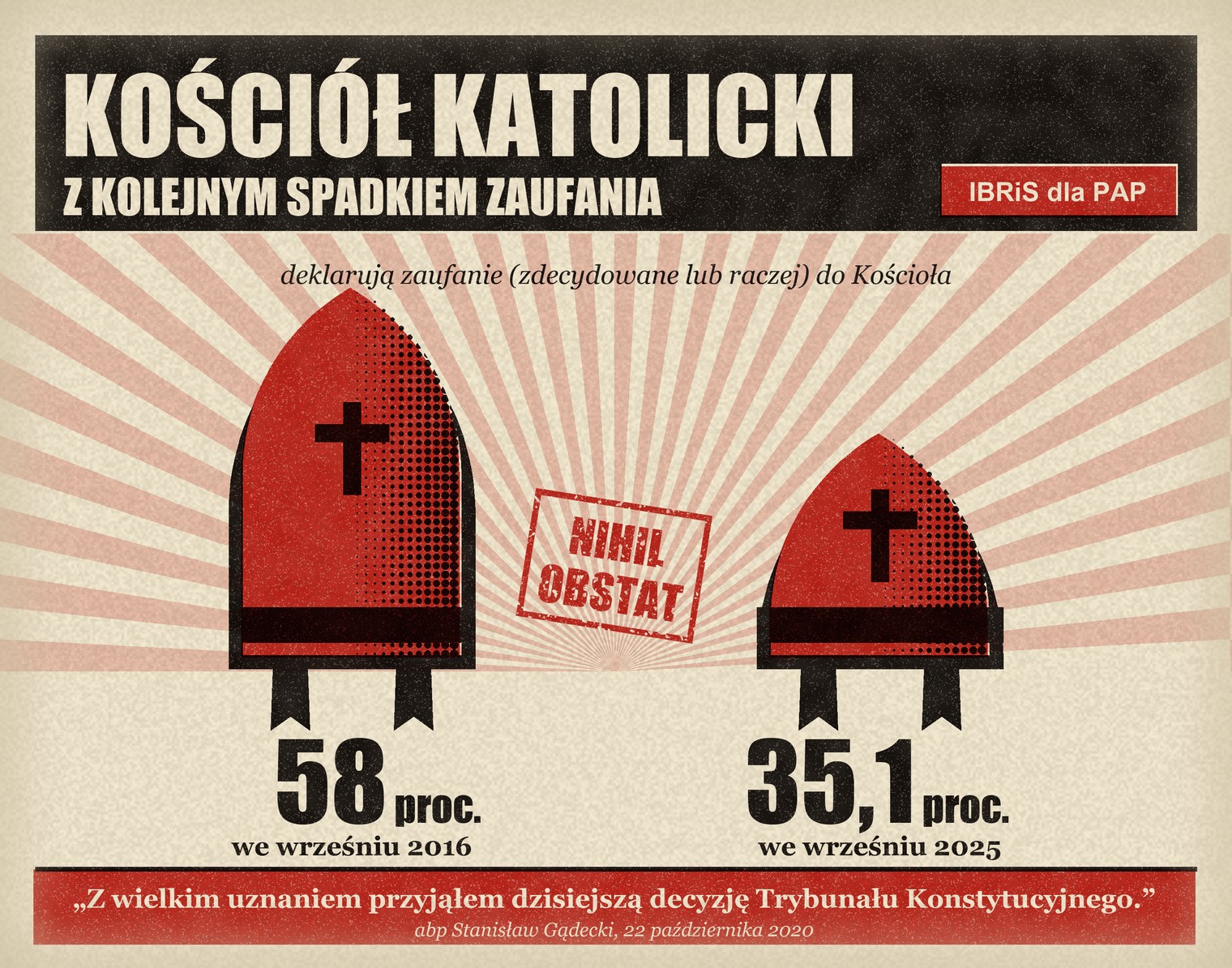
Z wielkim uznaniem przyjąłem dzisiejszą decyzję Trybunału Konstytucyjnego.
I received today’s decision of the Constitutional Tribunal with great appreciation. Protests followed, and some of them reached churches. On 27 October Jarosław Kaczyński, chairman of the governing Law and Justice party (PiS), spoke in a video posted on the party’s Facebook page. “We must defend Polish churches at any cost,” he said, as Notes from Poland reported, and he called on “all PiS members and all those who support us to take part in the defence of the church”, which he described as the “repository of the only moral system commonly known in Poland”.
The next day Gądecki spoke again. The ruling, he said, “has caused unusually emotional reactions”, and he condemned “the vulgarities, abusive daubings, service disruptions and profanations” of recent days, according to Catholic News Service. He asked for dialogue “on how to protect the right to life and women’s rights”. He also said: “On this question, we can accept no compromise.”
What the record holds is a hierarchy that welcomed a ruling and a party leader who asked his members to stand guard at its churches. No statement I found has the bishops endorsing PiS. In February 2021 a survey on the Ariadna panel for the statistics site ciekaweliczby.pl found 82% of Poles saying the Church should stay neutral in politics and 67% rating its political engagement as excessive. Among PiS voters, 68% wanted it neutral.
Poland voted on 15 October 2023. Turnout, by the electoral commission’s announcement, was 74.38%, which the Skalny Center calls the highest in Poland’s post-transformation history. PiS came first, with 7,640,854 votes and 194 of the 460 seats. The Civic Coalition took 157, Third Way 65 and the New Left 26, which comes to 248 by my arithmetic, and PiS lost power.
Figures from IBRiS for PAP and Gądecki’s words from Vatican News.
Trust moved further. In September 2016, IBRiS found, 58% of Poles said they trusted the Catholic Church. In a survey for the PAP news agency on 12 and 13 September 2025, 1,067 adults by phone, it was 35.1%, and distrust had nearly doubled, from 24.2% to 47.1%. Kamil Smogorzewski, IBRiS’s director of communications, said: “mamy do czynienia z kryzysem zaufania o niespotykanej dotąd dynamice”, we are facing a crisis of trust moving faster than ever before.
The series does not say why. The same nine years hold the Church’s abuse scandals, and the 2016 baseline was already taken under a PiS government. Attendance, for the years I have figures, held steady. The Church’s own statistics institute, ISKK, counted 29.6% of Catholics at Sunday Mass in 2024, against 29.2% in 2023 and 28.3% in 2021, rmf24 reported, and 14.6% taking communion. None of these sources says what part, if any, the bishops’ closeness to the government played in the fall in trust.
Washed Away
On Sunday 25 September 2022, after the liturgy at the Alexander Nevsky Skete outside Moscow, Patriarch Kirill gave a sermon that his press service published that afternoon. He prayed that the war would end as quickly as possible, “so that as few brothers as possible kill one another in this fratricidal war”. Then:
If someone, moved by a sense of duty, by the need to fulfil his oath, remains faithful to his calling and dies in the performance of his military duty, then he is undoubtedly performing an act equivalent to sacrifice. He sacrifices himself for others. And therefore we believe that this sacrifice washes away all the sins that the person has committed.
Translated from the Russian.
On 6 October his press service announced that he had blessed every diocesan bishop to organise pastoral care for the mobilised at enlistment offices and mobilisation points, in cooperation with the heads of Russia’s regions, for those called up under the partial mobilisation the president had announced. Clergy would hold services of intercession with words of farewell for military service, give out prayer books, small crosses and icons, and hear confessions and baptise on request, as far as they could.
The United Kingdom sanctioned him on 16 June 2022 “for his support and endorsement of Putin’s war”. The European Union dropped him from its sixth package that month to secure Hungary’s agreement, RFE/RL reported. In 2024 a decree approved under his chairmanship called the war in Ukraine “a Holy War”, which the World Council of Churches said it could not reconcile with what Kirill had told its general secretary in May 2023: that his references to holy war “were related to the metaphysical realm”.
This July the EU tried again, in its 21st package. Bulgaria’s foreign minister, Velislava Petrova, said Kirill and the Lukoil founder Vagit Alekperov were “no longer in the proposed package”, Ukrainska Pravda reported. According to European Pravda, Italy joined Bulgaria’s demand, “apparently influenced by the Vatican’s opposition” to what it saw as “political” sanctions on religious figures, and Kirill was removed from the proposed list. That account of Italy’s reasons is one outlet’s, and hedged. I could not open the EU Council’s own release, so as of 4 October 2026 I have not checked the adopted list myself.
Paperwork
In Warsaw and Moscow the people who could object were bishops, and they acted. The American military has no bishops. It has a chaplaincy, a corps of clergy commissioned as officers to minister to troops of every faith and of none, and its employer is the Secretary.
His file with the department starts with an email. On 14 January 2021 the D.C. National Guard’s security manager flagged a “Deus Vult” tattoo on Major Pete Hegseth as a possible “Insider Threat”, AP reported in November 2024. Hegseth has said he was unfairly identified as an extremist because of a cross tattoo on his chest.
On 21 May 2025 he hosted what his aide called the “first monthly Christian Prayer and Worship Service at the DoD”, in the Pentagon auditorium, broadcast on the building’s internal network, with a video posted by the department, Military.com reported. His pastor, Brooks Potteiger, prayed “for our leaders who you have sovereignly appointed”, naming President Trump. Hegseth told the room, by Military.com’s account of an audio recording, that a moment of prayer on bended knee was where he and the nation needed to be.
In February 2026 the preacher was Doug Wilson of Christ Church in Moscow, Idaho, who told the auditorium that “if you bear the name of Jesus Christ, there is no armor greater than that”, Word&Way reported. The Pentagon’s press secretary said Hegseth “was glad to welcome Pastor Wilson to the Pentagon today” (Military.com). In July Wilson told NPR he wants to repeal women’s right to vote. Asked why, he said: “Because it’s a good idea.”
Then the chaplains themselves. “Our chaplains are chaplains, not emotional support officers, and we’re going to treat them as such,” Hegseth said in a video posted on 17 December 2025. The Army’s spiritual fitness guide, he said, “mentions God one time. That’s it. It mentions feelings 11 times,” so “we’re tossing it” (Stars and Stripes). In March he announced that chaplains would stop wearing rank insignia and wear only their religious insignia, while keeping their rank. “A chaplain is first and foremost a chaplain, and an officer second,” he said, as Pentagon News reported.
1. Insignia, not rank
“Chaplains will still retain their ranks, Hegseth said in a video announcement Tuesday, but the change is meant to highlight the importance of the chaplain’s role as a religious leader.”
Stars and Stripes on the announcement of 24 March 2026.
“Since 2017, the Defense Department has recognized 221 groups as religious denominations or belief systems, ranging from mainstream to obscure Christian sects, Wiccans and atheists.”
Military.com and Task & Purpose put the old list at 211, so the post says more than 200. The new list has 31 codes.
“This restructuring of faith codes, which help identify service members as well as the military in planning for appropriated religious coverage to include them, has now excluded minority faith/worldview groups including Atheists, Asatru, Deists, Druids, Eckankar, Heathens, Humanists, Magick, New Age churches, Pagan, Rosicrucianism, Shaman, Spiritualists, Troth, Unitarian Universalists and various Wiccans.”
No Religion (NR) and Other Religions (OR) are among the 31 codes on the list Military.com published from the memo of 20 May 2026.
“Those who do not update their RAC before the deadline will have their records automatically changed to an “approved transition construct,” the statement says.”
Active-duty airmen and guardians have until 16 October 2026; the Air Force Reserve and Air National Guard until 9 November.
Words from Stars and Stripes, Military.com and Air Force Times.
The faith codes would go to 31 from more than 200. Stripes counts 221; Military.com and Task & Purpose count 211. A memo signed on 20 May by Anthony Tata, the under secretary for personnel and readiness, made the cut. The list Military.com published keeps two catch-alls, “No Religion” and “Other Religions”, and drops Atheists, Humanists, Pagans, Druids and “various Wiccans”.
On 25 March, at the first monthly service since the war with Iran began, Hegseth read a prayer that, he said, had been sent to him by “the chaplain who oversaw the Maduro raid”, the operation that captured Nicolás Maduro of Venezuela, and prayed with the troops before it. From the department’s video of the service, which AP reported the same day:
Let every round find its mark against the enemies of righteousness and our great nation. Give them wisdom in every decision, endurance for the trial ahead, unbreakable unity, and overwhelming violence of action against those who deserve no mercy.
Ronit Stahl, a historian of the military chaplaincy, told AP that broad references to God are not unusual in that setting, but “the shift towards the specificity of Jesus Christ and therefore Christianity and in Hegseth’s case, a particular form of Protestant Christianity, is new, especially coming from the defense secretary.” The war is still going on. GlobalSecurity’s daily log counted day 219 on 4 October 2026.
The Memo
The State of the Force address put a number on the faithful. From the transcript: “less than 5% of our force identifies as non-religious. Less than 5%. Meaning, 95% of our force recognizes an Almighty God.” The Pentagon has not released an official religious breakdown since 2019, Military Times reported, when active-duty personnel were 70% Christian, 2% atheist or agnostic and 24% unclassified or unknown. The 95% is unsupported by the Pentagon’s own data. A quarter of the force sits in a box nobody can read as belief in God. With the Atheist and Humanist codes gone, the next count will also be harder to set against that one; that is my reading of the change, not the department’s.
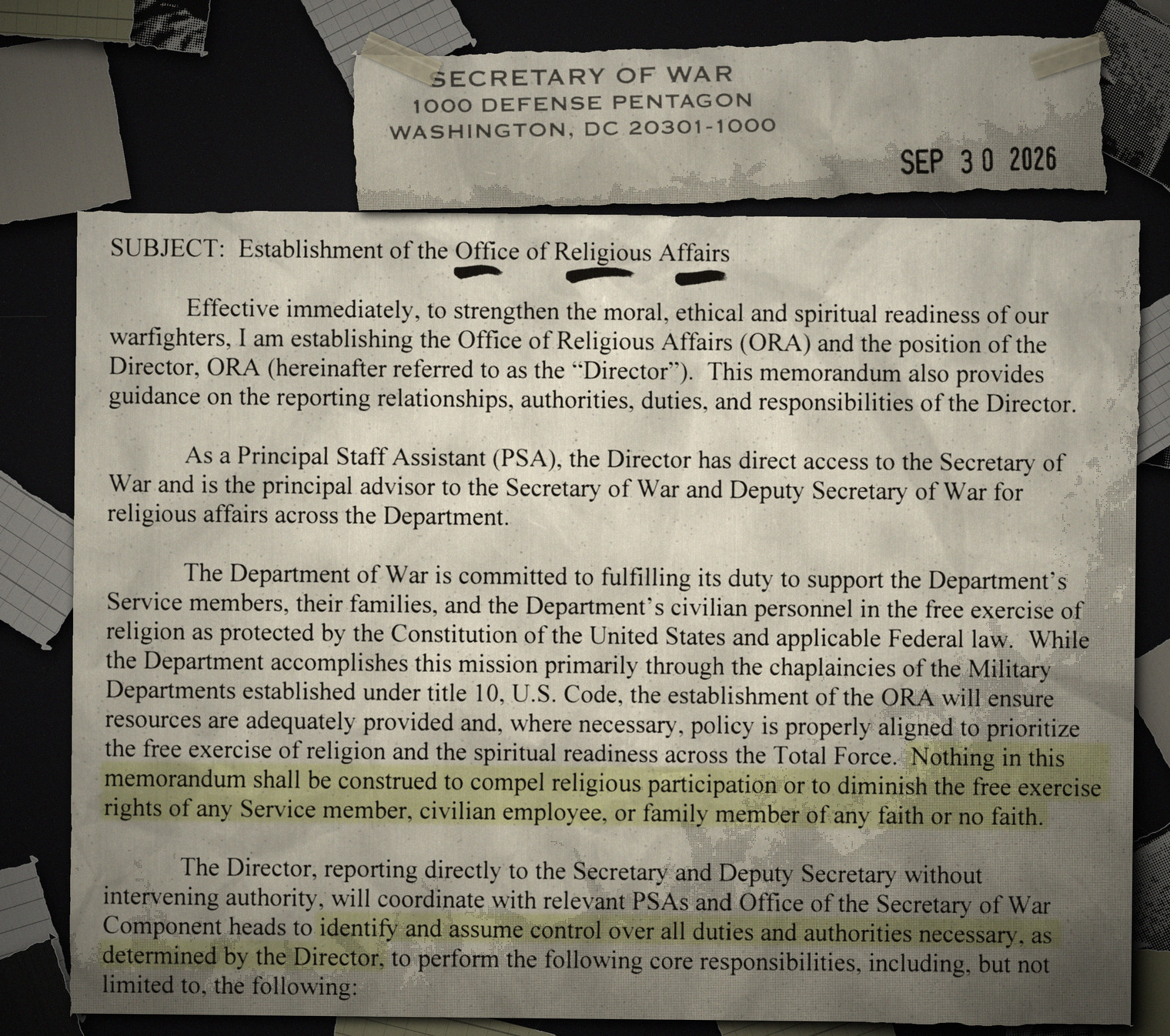
He described the office as having “real teeth” and said it would not be “a paper pushing shop”. It was set up by a two-page memorandum, dated 30 September, which opens “Effective immediately”. The Office of Religious Affairs has a Director who reports to the Secretary and his deputy “without intervening authority”. The Armed Forces Chaplains Board, which advises the Secretary on chaplains, moves “under the authority, direction, and control of the Director”. The office is to make sure the department and the military departments fund, among other things, “faith-based homeschool support for military families” and “contracted services from faith-based non-Federal entities”. Within 90 days the military departments must report all their “unfunded and underfunded religious affairs requirements”. As of 2 October, AP reported, no director had been named.
Two cuts from page 1 of the memorandum of 30 September 2026, a U.S. government work, with olive highlighting added.
The protection and the power sit one paragraph apart. One sentence protects the troops: “Nothing in this memorandum shall be construed to compel religious participation or to diminish the free exercise rights of any Service member, civilian employee, or family member of any faith or no faith.” The next paragraph tells the Director to “identify and assume control over all duties and authorities necessary, as determined by the Director”. Nobody is compelled to pray. The office that decides how chaplains are resourced, advised and governed decides the size of its own remit.
In the same speech Hegseth reached back to 1775. “That force appealed to Heaven,” he said of Washington’s army, “and we still do today.” Part two followed that phrase from a colonel’s flag to a justice’s beach house.
Objections so far have gone through paperwork too. In March Americans United for Separation of Church and State filed two Freedom of Information Act suits against the Departments of Defense and Labor, seeking records of their prayer services, Military.com reported. On 6 March thirty House members, led by Jared Huffman, Jamie Raskin and Chrissy Houlahan, wrote to the inspector general after reports that some commanders had told subordinates the attacks on Iran “will hasten the return of Jesus Christ”. They asked him to assess whether “Secretary Hegseth’s extreme religious rhetoric has metastasized into segments of the military chain of command”. The Military Religious Freedom Foundation said it had received “well in excess of 200” complaints, by its own count.
Filed Before
The department has investigated religious speech by its own senior officers before, and the files show what the checks were built to catch. In August 2004 its inspector general reported on Lieutenant General William Boykin, the deputy under secretary for intelligence, who had spoken at 23 religious-oriented events since January 2002, mostly in uniform. He had broken the rules, it found, because “he failed to clear the content of his speeches with appropriate DoD security and public affairs personnel”, failed to give the required disclaimer, and failed to report a travel payment. On what he actually said: “we did not determine whether the substance of LTG Boykin’s faith-based statements constituted an appropriate topic for a speech by a senior DoD official”.
The root of this problem is not overt religious discrimination, but a failure to fully accommodate all members’ needs and a lack of awareness over where the line is drawn between permissible and impermissible expression of beliefs.
Under both sits a court ruling from 1985. In Katcoff v. Marsh the Second Circuit upheld the Army chaplaincy, holding that the test was whether it “is relevant to and reasonably necessary for the Army’s conduct of our national defense”. Soldiers sent around the world need a way to practise their own faith, and the chaplaincy is it. The court doubted some of the edges. It noted that in some large cities, “such as at the Pentagon”, government money might be providing chaplains to “armchair” military personnel who commute home every day like other civil servants, and it sent those parts back for further review. The Pentagon now has an Office of Religious Affairs that answers to the Secretary without intervening authority.
Countersigned
For two posts the censor’s line stayed empty. In Western Europe’s emptied churches there was mostly nobody left to sign it. In American Protestantism nobody could sign it for anyone else, because a refusal there binds no church and costs the person who makes it. Here the line has a signature on it.
The president of the Polish bishops thanked the tribunal, the party leader sent his members to guard the churches, and nine years after 2016 the share of Poles who trust the Church had fallen from 58% to 35.1%. Nothing I have read proves the one caused the other. Kirill told the faithful that a soldier’s death in the line of duty washes away his sins, sent his clergy to the enlistment offices, and in July was dropped from the EU’s proposed sanctions list again. The chaplaincy, built to minister to every faith and none, is being reissued: fewer codes, new insignia, an advisory board moved under a Director who decides the reach of his own authority. The memo says nobody will be compelled. The chaplains are still serving, in a war that has not ended, under all of it.
Who is left to object? Who has the standing to object? What happens when the one who could object signs up? It can line up and lose the public’s trust, as the Polish Church may have, or hold back and be rewritten from inside by whoever employs it. Who could have said no? Nihil obstat.
Frame in the hero and the animation: The Metropolitan Museum of Art. “Tabernacle frame”, Venice, early 16th century. Open Access, CC0. The jacket, hanger, rail, cross, tag and stamps in the hero and the animation are drawn for this post.
Scraps in the background of the hero, the animation and the section images: Pfc. Jason Sessions, U.S. Army, DVIDS. “Answering the Call: A Chaplain’s Role in the U.S. Army.” Public domain; used only as small halftoned fragments of cloth and chairs, with no face or name.
Paper texture in the images: Photos Public Domain. “Crumpled olive green paper.” Public domain via Wikimedia Commons, used for creases only.
Britain sanctioned Xinbi with two wallets that were already dead. The money stopped a day before the announcement, when, by an analytics firm's account, a US agency went to Tether. The first new wallet opened 26 minutes later. This part asks who kept the gate open.
A Facebook ad for a waiter, a Telegram channel with 6,564 members and a frozen wallet the FBI ties to Xinbi. This is who the scam compounds recruit, and where the paper trail stops.
 Figures from IBRiS for PAP and Gądecki’s words from Vatican News.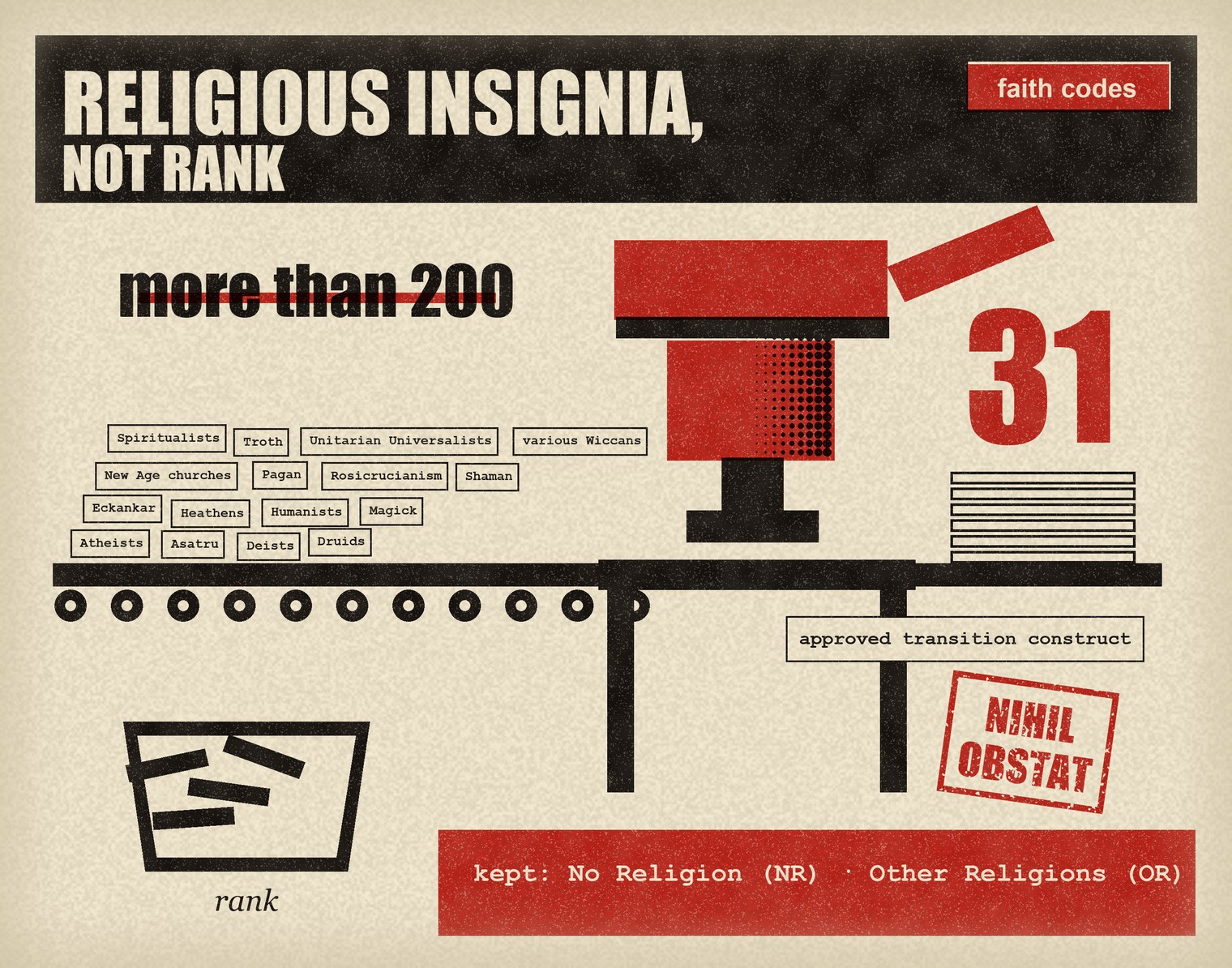
 Two cuts from page 1 of the memorandum of 30 September 2026, a U.S. government work, with olive highlighting added.