A prime minister with no competence on salvation, a party that does twice as well outside church as inside it and a cardinal who did not say the name: how the cross gets taken where the pews are empty
Viktor Orbán has said, on the record, that salvation is none of his business. “Neither states nor governments have competence on questions of damnation or salvation,” he told a summer university in Băile Tuşnad, Romania, on 28 July 2018, according to his government’s own transcript. In the same paragraph he said what he would defend instead:
Our duty is not to defend the articles of faith, but the forms of being that have grown from them.
The speech was a pitch for “Christian democracy” as the replacement for the liberal kind, and “the liberal elite can be replaced with a Christian democratic elite”. Doctrine, the part a priest could hold you to, he hands back. He keeps “human dignity, the family and the nation”, the ways of life “springing from Christian culture”, and the right to decide what those are.
That arrangement only works if nobody with standing objects. This series follows one question through three ways a movement gets its blessing: who could have said no? In Western Europe the question gets shorter. Who is left to object?
The Persuasion Problem
The strongest evidence against this whole series comes first. In June 2026 the American Political Science Review published a meta-reanalysis by Radha Sarkar and Alexander Coppock. They collected the original data from the experiments in the field, 58 treatment-outcome pairs from 43 studies in 26 papers, and re-ran them all the same way. Each experiment randomly showed people a religious message or a religious leader’s endorsement, then measured the political attitude the message was aimed at. The pooled effect of a religious message against a pure control, meaning no message or an unrelated one such as a weather report, was 1.1 points on a 0 to 100 scale, with a standard error of 0.8. Against an equivalent secular message it was 0.9 (standard error 1.0). For endorsements by religious leaders, 1.0 (standard error 1.3). None of the three averages can be distinguished from zero. Against a pure control, individual estimates ranged from minus 14 points to plus 31, so the effects are large in some places and close to zero in others. They also found no sign that religious people, or people of the faith in question, respond more than anyone else. Their verdict on the field’s three main claims: “none of these claims is correct in general.”
That result stands. It measures persuasion: whether hearing a religious message changes your mind about an issue. This series makes a different claim. A party that wraps itself in the cross is mostly not trying to change minds about immigration. It is telling people who already agree that their view comes with a blessing, and binding them to the party that said so. That is a claim about legitimacy and loyalty, and the experiments do not test it. Nobody in their corpus was randomly assigned a rosary at a rally. I do not have an experiment that tests my version either. What I have is who votes for what, and who said no.
Belonging Without Attending
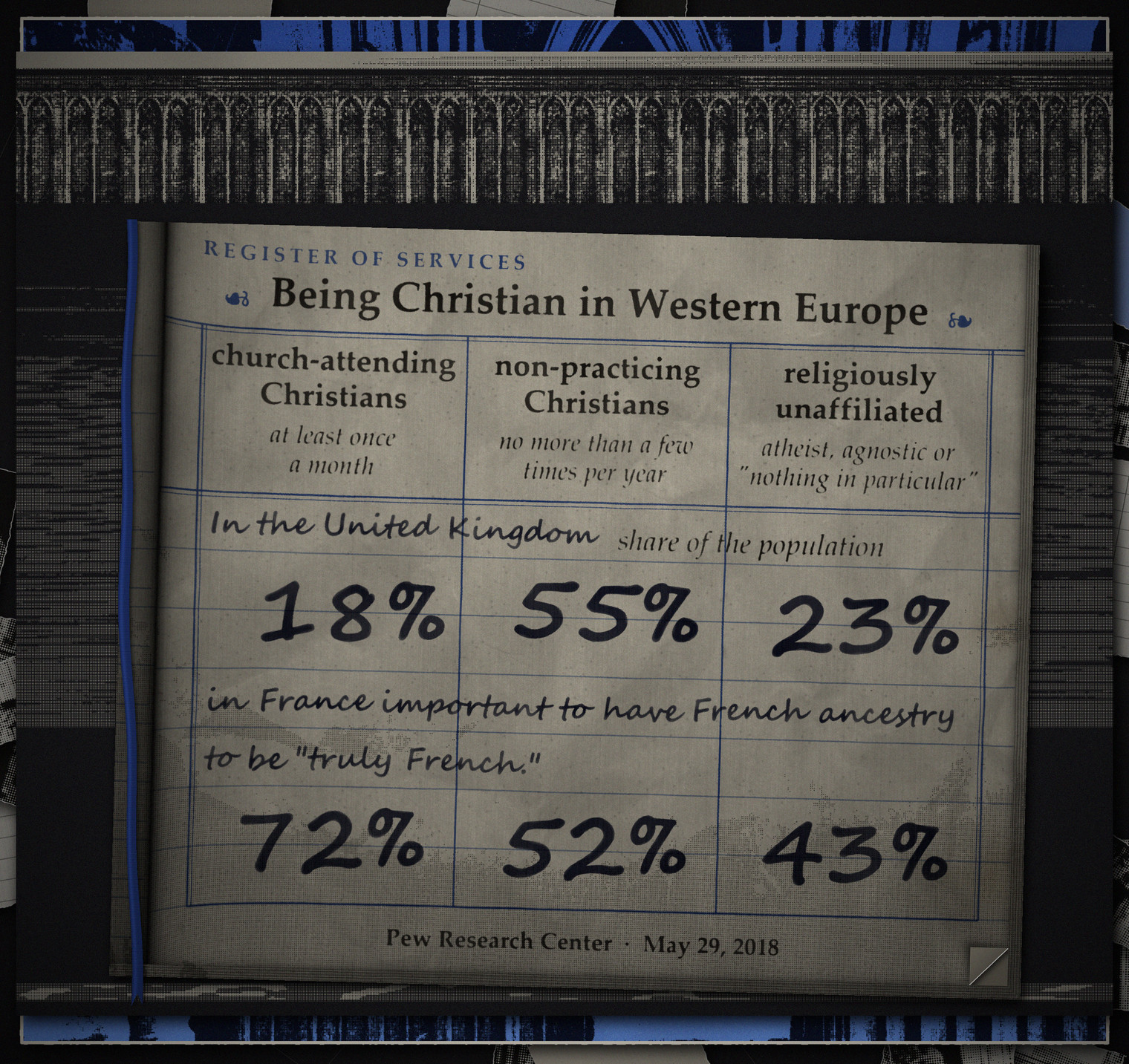
The best map of the ground is still Pew’s 2018 survey, Being Christian in Western Europe: 24,599 adults in 15 countries, interviewed by phone in 2017. Pew splits Christians by practice. “Church-attending Christians” go at least once a month. “Non-practicing Christians” identify as Christian but go “no more than a few times per year”. In every country except Italy, the second group is bigger. In the United Kingdom, Pew counts “roughly three times as many non-practicing Christians (55%) as there are church-attending Christians (18%)”.
Pew’s headline finding, in its own words, is “a strong association between Christian identity and nationalist attitudes, as well as views of religious minorities and immigration, and a weaker association between religious commitment and these views.”
Now the part that does not fit neatly, and Pew says it plainly. Non-practising Christians “are less likely than church-attending Christians to express nationalist views. Still, they are more likely than ‘nones’”. In France, 72% of churchgoing Christians say it is important to have French ancestry to be “truly French”, against 52% of non-practising Christians and 43% of the unaffiliated. On the ancestry question the full pews score highest. The identity travels without the attendance, and there is far more of it.
The Litany
The numbers that sent me down this road come from France. On the day of the European election, 9 June 2024, Ifop surveyed 2,871 registered voters for La Croix, the Catholic daily, and broke the vote down by religious practice.
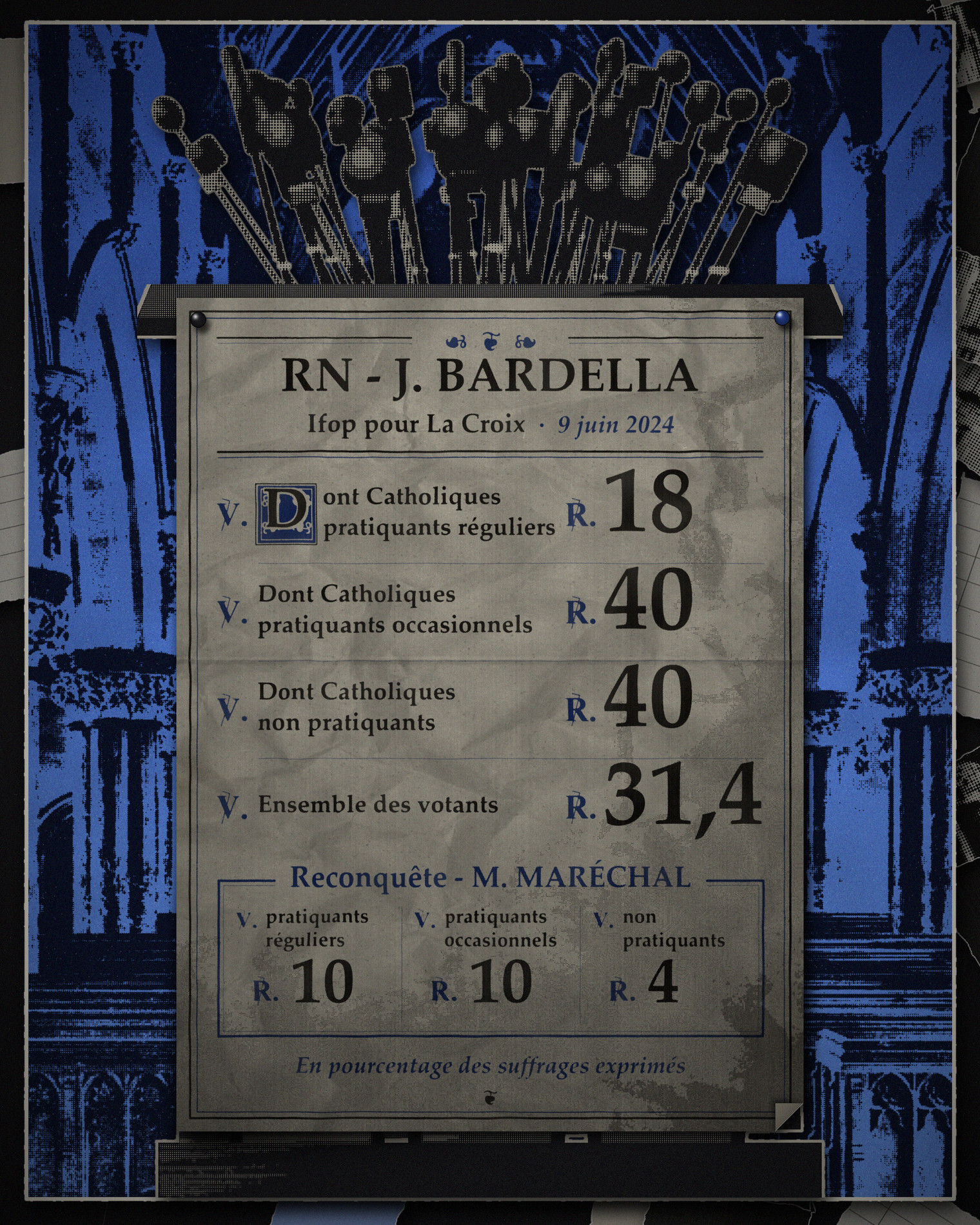
The vote by Catholic practice from the Ifop report, printed page 6.
The RN list, led by Jordan Bardella, took 31.4% of the vote. Among Catholics who practise regularly it took 18%. Among occasional practisers, 40%. Among non-practising Catholics, also 40%. Ifop’s own summary makes the same point: regular practisers “ne sont que 18%”, are only 18%, to have voted for the party’s leader. The RN’s best Catholic voters are the ones the parish rarely sees.
Then the exception. Reconquête, Marion Maréchal’s list, runs the other way: 10% among regular practisers, 10% among occasional ones, 4% among non-practising Catholics. If you add the two lists together, which is my arithmetic and not Ifop’s, regular practisers come to 28%, occasional practisers to 50% and non-practisers to 44%. The gap between the full pews and the empty ones narrows but survives, and the occasional churchgoers top both. The RN is the empty-pew party; its smaller rival does better in the full ones. This is one survey, taken online on polling day, and Ifop does not print how many regular practisers were in the sample, so I would not lean on the last digit of any of these.
Nobody Named
By 20 June 2024 parliament had been dissolved and France was heading into a snap election, with the RN in front. That day, the permanent council of the French bishops’ conference published a prayer and a statement. Read whole, it sounds like an institution that has decided not to be quoted.
Comme tous nos concitoyens, nous, catholiques, avons à exercer notre responsabilité démocratique.
Like all our fellow citizens, we Catholics have our democratic responsibility to exercise. It urges “nous tous Français”, all of us French, “à ne pas diffuser la colère et la haine”, not to spread anger and hatred. It names no party and gives no voting instruction.
It does contain one striking diagnosis. Among the causes of France’s malaise it lists “l’effacement de Dieu dans la conscience commune”: the effacing of God from the common consciousness. The bishops wrote the thesis of this post and then declined to apply it. Writing in Esprit that September, Pierre-Louis Choquet noted that many observers had remarked on the “très grande prudence”, the very great caution, of the bishops’ conference after the RN’s wins. The research for this series found no statement from the conference naming the RN before the first round or between the rounds. Absence is hard to prove, so treat that as the limit of what I found.
The people who actually acted were politicians. According to franceinfo, citing the Interior Ministry, about 215 candidates who had qualified for the second round stood down “afin de faire barrage au Rassemblement national”, to block the RN. Three-way run-offs including the RN or its allies fell from 299 to 86. In Choquet’s account, the RN was routed in the run-off of 7 July “grâce au maintien du front républicain”, thanks to the republican front, and still took more than 10 million votes. The French Church had a prayer already written and the diagnosis on the record.
Nicht Wählbar
Germany is the case where the hierarchy did say no, in writing. On 22 February 2024 the plenary assembly of the German bishops adopted a declaration titled “Völkischer Nationalismus und Christentum sind unvereinbar”, ethnic nationalism and Christianity are incompatible. Its diagnosis names the party: in the AfD, “dominiert inzwischen … eine völkisch-nationalistische Gesinnung”, an ethnic-nationalist mindset now dominates. The operative sentence is general:
Rechtsextreme Parteien und solche, die am Rande dieser Ideologie wuchern, können für Christinnen und Christen daher kein Ort ihrer politischen Betätigung sein und sind auch nicht wählbar.
Far-right parties, and those that grow at the edge of that ideology, cannot be a place for Christians’ political activity, and are not electable. The AfD is named in the diagnosis; that sentence names no party. katholisch.de, the German Catholic news portal, reads it as the first time the bishops called a party in the Bundestag unelectable for Christians.
A year later, at the federal election of 23 February 2025, the AfD doubled its share to 20.8%, from 10.4%. On 6 September 2026, in the eastern state of Saxony-Anhalt, it took 43.8% and 39 of 83 seats, three short of a majority, on a turnout of 77.8%, according to the bpb, the federal agency for civic education, working from the provisional official result. The new parliament sat for the first time on 6 October and elected the AfD’s Tobias Rausch as its president, by 48 votes to 29 with 5 abstentions. As of 11 October 2026 the state has no new government: the old coalition has lost its majority, and the outgoing premier stays on until one is formed.
So did the veto work? Start with who could hear it. The declaration came from the Catholic bishops, and Saxony-Anhalt has very few Catholics. The Sonntagsblatt counts 64,841 of them, against about 230,000 Protestants: together just under 295,000 people, 13.8% of the state. By my arithmetic the Catholics are about 3%. From a Konrad-Adenauer-Stiftung analysis, the paper reports that the AfD took 33% of Protestant voters, 32% of Catholics and 47% of people with no religion, 15 to 19 points more among church members than in 2021. It is careful about what that shows: the figures “zeigen zunächst nur einen Zusammenhang, aber keine Ursache”, show a link and not a cause. It is also blunt: it would be wrong to conclude “dass eine Kirchenmitgliedschaft automatisch vor einer Wahl der AfD schützt”, that church membership automatically protects against an AfD vote.
The national gradient by practice is steeper. Allensbach polling from September 2025, cited by the journalist and writer Andreas Püttmann, had the AfD at 24% among voters naming a party, 31% among people with no church, 23% and 22% among Protestants and Catholics who keep their distance from church, and 11% and 10% among those who go at least “ab und zu”, now and then. At the 2025 federal election, the polling-day surveys compiled by fowid put the AfD at 20% of Protestants, 19% of Catholics and 24% of the unaffiliated.
People who stay close to a church are not a random sample. They differ in age, region and a dozen other ways from people who drifted off. These tables show that the closer you are to a church, the further you tend to be from the AfD. They cannot show that the bishops’ declaration moved a single vote.
A Rosary in Piazza Duomo
Italy is the short case and the clearest picture. On 18 May 2019, eight days before the European election, Matteo Salvini closed a rally of Europe’s nationalist leaders in Milan’s Piazza Duomo holding a rosary. “Affido la mia e la vostra vita al cuore immacolato di Maria che sono sicuro che ci porterà alla vittoria,” he said, as Il Sole 24 Ore reported: I entrust my life and yours to the immaculate heart of Mary, who I am sure will lead us to victory.
The next day the Vatican’s Secretary of State, Cardinal Pietro Parolin, was asked about it at an event in Rome:
Io credo che la politica partitica divida, Dio invece è di tutti. Invocare Dio per se stessi è sempre molto pericoloso.
I believe party politics divides, while God belongs to everyone. Invoking God for oneself is always very dangerous. Il Sole is careful to say that Salvini “non viene citato esplicitamente”, was not named, and that the words “sembrano fare riferimento”, seem to refer, to the rally. Others were less careful. Father Antonio Spadaro, a Jesuit close to Pope Francis, tweeted a photo of a commemorative Donald Trump coin promoted by American evangelicals, and wrote, according to AP: “There are those who in electoral campaigns use God and saints, and those who even sell coins to pray for the re-election of their candidate,” and “The exploitation of religion seems to know no decency.” The Catholic weekly Famiglia Cristiana called it “the latest example of the exploitation of religion to justify the systematic violation of human rights in our country.”
Salvini’s reply, on Twitter: “I’ll continue to give witness to my Faith with my work for a more beautiful and secure Italy. Gossip I’ll leave to others. Amen.”
1. Not the articles of faith
“Neither states nor governments have competence on questions of damnation or salvation. Christian democratic politics means that the ways of life springing from Christian culture must be protected. Our duty is not to defend the articles of faith, but the forms of being that have grown from them.”
Viktor Orbán at the Bálványos summer university, Băile Tuşnad, 28 July 2018.
“Comme tous nos concitoyens, nous, catholiques, avons à exercer notre responsabilité démocratique.”
The permanent council of the French bishops' conference, 20 June 2024. It names no party. In English: Like all our fellow citizens, we Catholics have our democratic responsibility to exercise (my translation).
“Io credo che la politica partitica divida, Dio invece è di tutti. Invocare Dio per se stessi è sempre molto pericoloso.”
Cardinal Pietro Parolin, the Vatican's Secretary of State, the next day. Il Sole notes he did not name Salvini. In English: I believe party politics divides, while God belongs to everyone. Invoking God for oneself is always very dangerous (my translation).
“Affido la mia e la vostra vita al cuore immacolato di Maria che sono sicuro che ci porterà alla vittoria”
Matteo Salvini closing his rally in Piazza Duomo, Milan, 18 May 2019, rosary in hand. In English: I entrust my life and yours to the immaculate heart of Mary, who I am sure will lead us to victory (my translation).
“Rechtsextreme Parteien und solche, die am Rande dieser Ideologie wuchern, können für Christinnen und Christen daher kein Ort ihrer politischen Betätigung sein und sind auch nicht wählbar.”
The German bishops' declaration of 22 February 2024. The AfD is named in its diagnosis, not in this sentence. In English: Far-right parties, and those that grow at the edge of that ideology, cannot be a place for Christians' political activity, and are not electable (my translation).
Italy voted eight days later. I have seen no poll that isolates the rosary’s effect, or the rebuke’s, either way. What the Italian case shows is what an objection looks like when the hierarchy is still there to make one. It came, obliquely and without a name, and Salvini answered his Catholic critics with the line about gossip.
Where It Runs the Other Way
Two pieces of research complicate this, and one of them reverses it.
The first is a study of the 2016 European Social Survey in 15 countries by Marcinkiewicz and Dassonneville. In Western Europe they found no country where religiosity went with a higher vote for the populist radical right, and in many the more religious were less inclined to it. In the East it flips: “In Poland, and to a weaker extent also in Hungary, the probability of a vote for right-wing populists increases with religiosity.” My reading is that where the governing party has the hierarchy on side, the full pews become part of its base. That is the subject of part three.
The second is older and quieter. In 2009 Arzheimer and Carter found that religious West Europeans were “neither more nor less hostile towards ethnic minorities” than anyone else. They were simply not “available” to radical right parties, because they were still attached to Christian Democratic or conservative ones. They called it a “vaccine effect” and predicted that with de-alignment it “is likely to become weaker with time”. For Germany, Siegers and Jedinger, using pooled election-study tracking data, found that religiosity “tends to indirectly ‘immunise’” citizens against the AfD by two routes: church attendance goes with weaker anti-immigrant attitudes, and every kind of religiosity goes with attachment to the established parties. They concluded that the AfD’s success in the East “is partly due to advanced secularisation in this part of the country.” The two papers share the party route; on attitudes they differ, since Arzheimer and Carter found no difference. I have only read the abstracts of all three papers, so I am quoting them and nothing more.
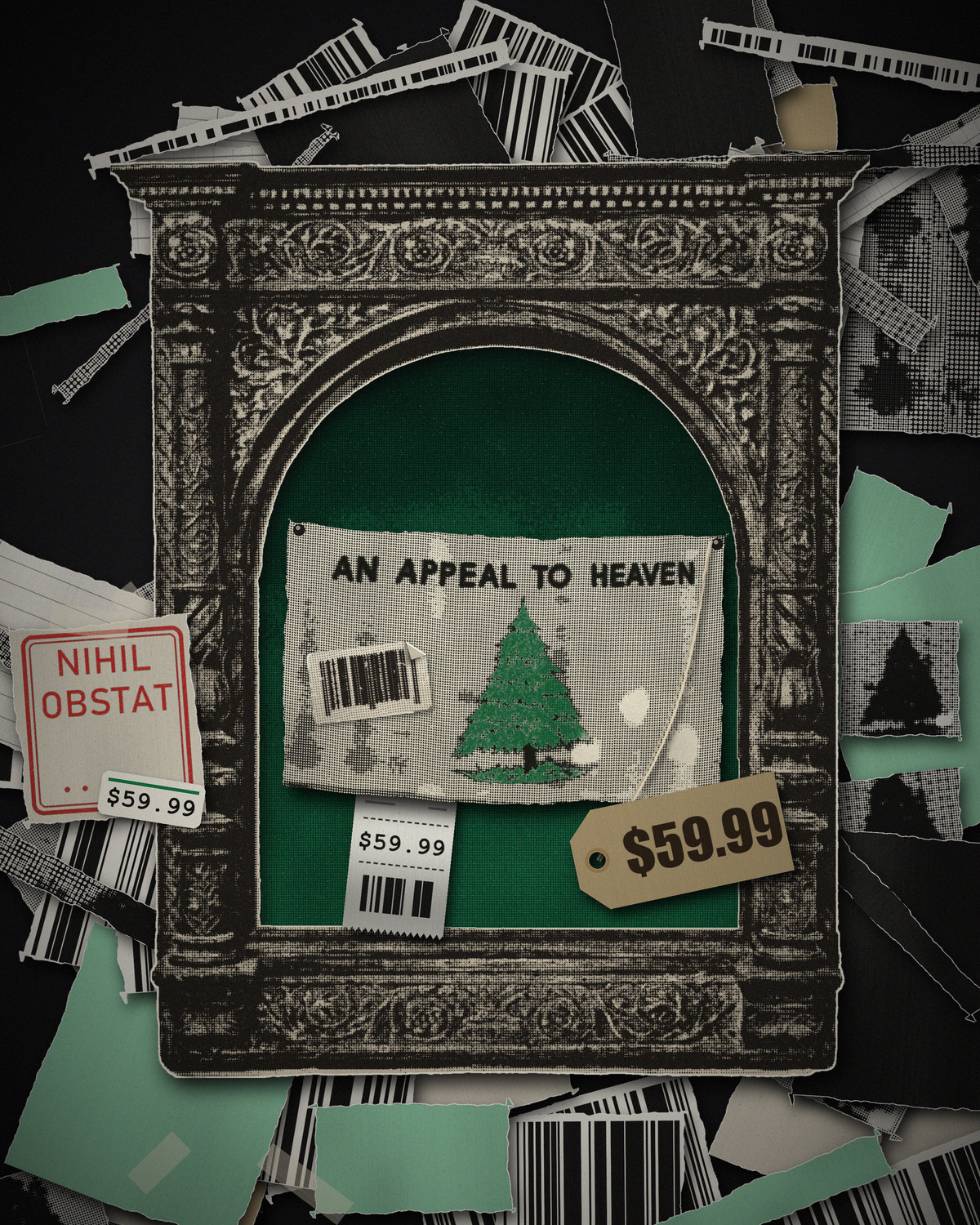
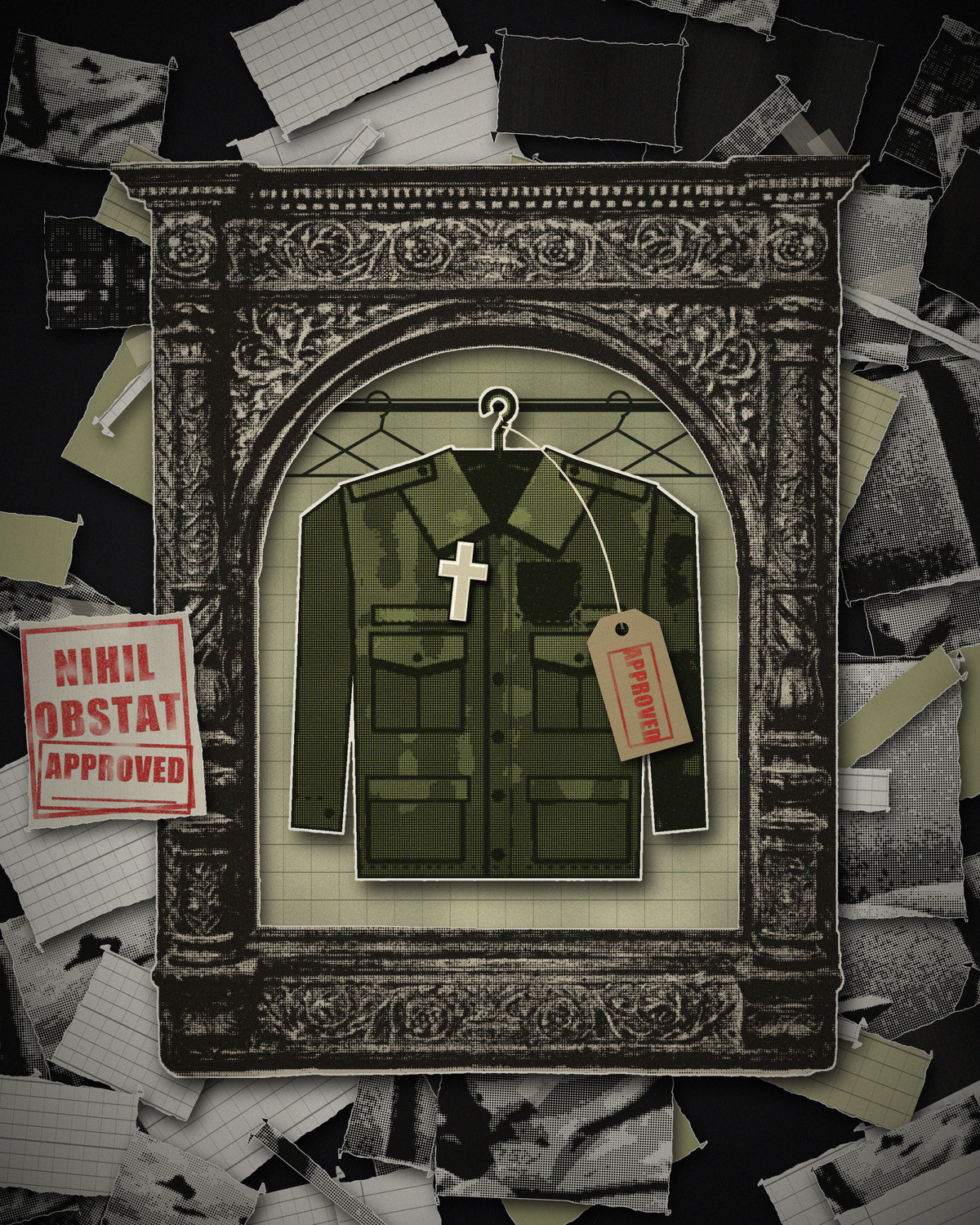
Nihil Obstat
Before a Catholic book was printed, a censor read it. If he found nothing against faith or morals, he wrote two words, and the bishop’s approval followed. In the Catholic Encyclopedia’s 1908 description, the bishop’s Imprimatur “is to be preceded by Nihil obstat, together with the name of the censor.” Canon law still asks the censor to give his opinion in writing. Nihil obstat: nothing stands in the way, with a name under it.
That is the device for this series, and in this part the line where the name goes is blank. In France the bishops had the words and signed nothing I could find, and other people blocked the RN. In Germany the Catholic bishops signed, in a state where about one person in thirty is Catholic, and nobody can say how many votes the signature moved. In Italy the Vatican came close to signing, and the borrower left the gossip to others.
The cross is freest to take where Christian identity is high and Christian practice is low: Pew’s non-practising Christians, the biggest group in the region, the RN’s 40% among non-practising Catholics. Where even the identity has thinned out, as in Saxony-Anhalt with 13.8% still in a church, there is hardly anyone left to hear a no. The exceptions are real and I have named them. French churchgoers score highest on Pew’s ancestry question, and Reconquête does best among the Catholics who still go. In Poland and Hungary the pattern turns over entirely. When a politician borrows the faith for the forms of being and leaves the articles behind, the people with the standing to object are mostly no longer in the room.
Orbán said the state has no competence on damnation or salvation, and he was right. He kept the label anyway, and in churches this empty there was nobody left to ask for it back. Across the Atlantic nobody can enforce a no, and saying it costs you. Who could have said no? Nihil obstat.
Church interior in the hero and images: Library of Congress Photochrom Print Collection. “Bodelwyddan Church (interior), Rhyl, Wales.” c. 1890 to 1900, public domain. The lectern, microphones and stamp are drawn for this post; the pew is built from this photograph and the wood texture in 28.
Frame in the hero and noticeboard: The Metropolitan Museum of Art. “Tabernacle frame”, Venice, early 16th century. Open Access, CC0. Three small carved masks were replaced with the frame’s own rosettes.
Paper texture in the images: Photos Public Domain. “Crumpled olive green paper.” Public domain via Wikimedia Commons. Used for its creases only.
Wood texture for the pew: Bango Textures (ISO Republic). “Wood Texture Background.” CC0 via Wikimedia Commons.
Britain sanctioned Xinbi with two wallets that were already dead. The money stopped a day before the announcement, when, by an analytics firm's account, a US agency went to Tether. The first new wallet opened 26 minutes later. This part asks who kept the gate open.
A Facebook ad for a waiter, a Telegram channel with 6,564 members and a frozen wallet the FBI ties to Xinbi. This is who the scam compounds recruit, and where the paper trail stops.
 Two rows from
  The vote by Catholic practice from the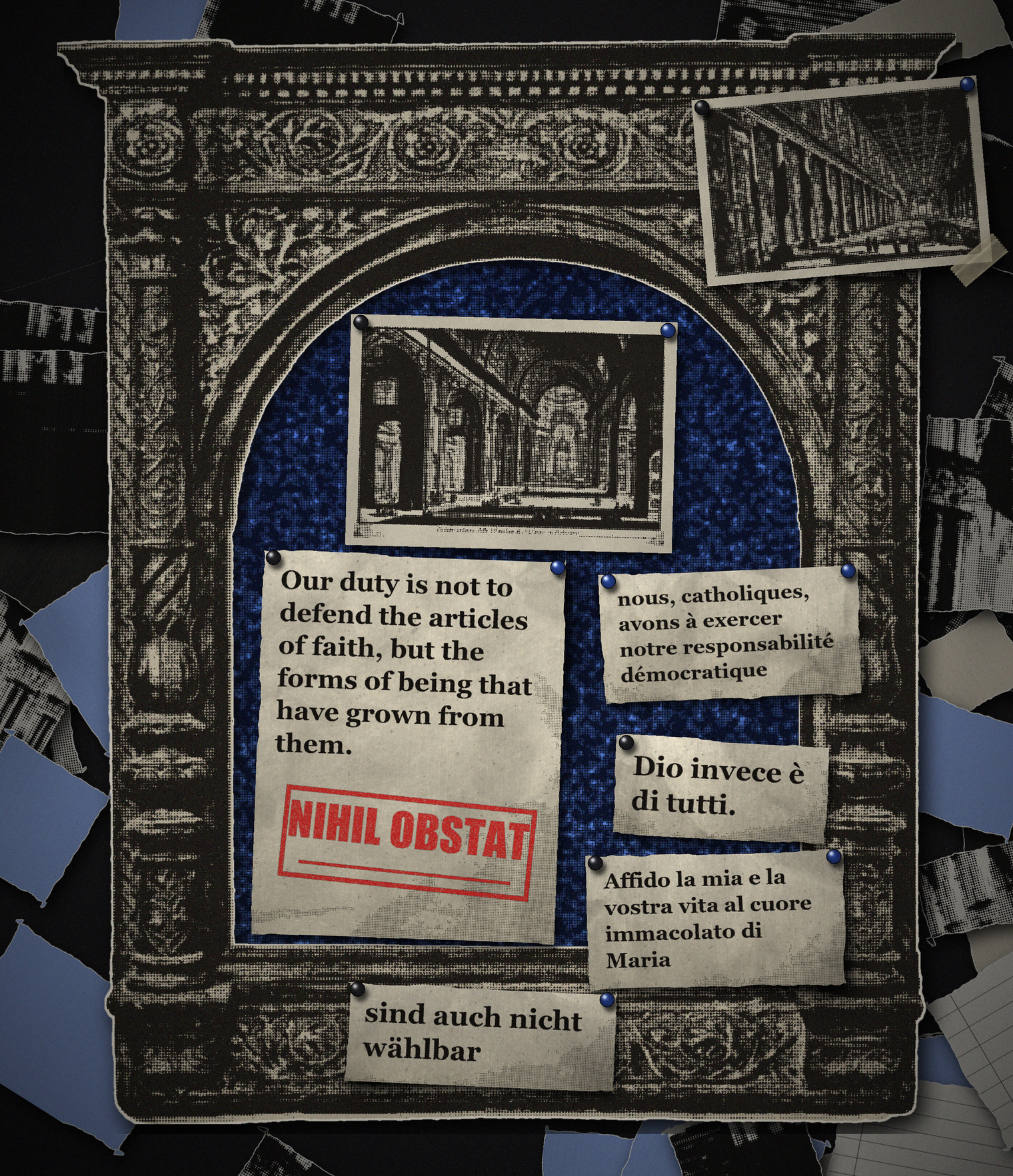



,_Rhyl,_Wales-LCCN2001703541.jpg)


